

A Banking Power of Attorney in UAE allows an account holder or another legally authorised person to appoint someone else to carry out specified banking transactions on their behalf. These may include collecting bank statements, transferring funds or managing an account, depending on the powers granted in the document and the bank’s requirements.
However, having a Power of Attorney notarised does not automatically mean that a bank will accept it. The bank must verify the agent’s identity and authority before allowing the agent to conduct transactions.
This guide explains the legal requirements for issuing a Banking Power of Attorney in the UAE, the documents needed, the powers that may be delegated, notarisation procedures, fees, revocation and the reasons a bank may reject a POA.
What Is a Banking Power of Attorney in the UAE?
A Banking Power of Attorney (POA) is a legal authorisation through which one person, known as the principal, appoints another person, known as the agent, to represent them before one or more banks and conduct specified banking transactions in their name and on their behalf.
Powers of Attorney in the UAE are governed by Federal Decree-Law No. 25 of 2025 Promulgating the Civil Transactions Law, which came into force on 1 June 2026.
Article 866 defines agency as a contract under which the agent undertakes to perform a legal act in the name and on behalf of the principal. The subsequent provisions govern the validity, scope and legal effects of the agency.
A banking POA may be useful in several situations, including:
- The account holder is outside the UAE and cannot visit the bank.
- The principal wishes to authorise someone to collect bank documents or statements.
- A trusted person needs to handle specified banking transactions.
- A company needs to be represented before a bank by an authorised signatory.
- The account holder cannot personally complete a particular banking transaction.
The term Banking Power of Attorney does not, by itself, grant a standard set of powers to every agent. The scope of authority depends on the wording of the POA, the nature of the transaction and the requirements of the receiving bank.
What Are the Requirements for Issuing a Banking POA and Getting Bank Approval?
A Banking Power of Attorney must satisfy the legal requirements governing agency in the UAE. Its use at a bank is also subject to notarisation, identity verification and the bank’s internal acceptance procedures.
It is therefore essential to distinguish between the legal validity of the POA and its acceptance by a financial institution.
Legal Requirements for a Valid Power of Attorney
Article 868 of the UAE Civil Transactions Law establishes three requirements for a valid agency:
- The principal must have the legal right to carry out the act being delegated.
- The agent must have the legal capacity to perform the authorised act.
- The subject matter of the agency must be identifiable and legally capable of being delegated.
Article 867 also addresses the formal requirements applicable to the legal act forming the subject matter of the agency.
Accordingly, the POA should clearly identify the principal, the agent and the transactions covered by the authorisation, while complying with the notarisation requirements applicable to the intended transaction.
Requirements for Bank Acceptance
Before allowing an agent to operate an account, a bank may require:
- A duly notarised Power of Attorney acceptable under its procedures.
- Identity verification for the principal and agent.
- A clear description of the authorised banking transactions.
- The bank’s name and the relevant account details, where necessary.
- The bank’s prescribed POA form, if required.
- Verification that the agent has authority to represent the account holder.
- Corporate documents and authorised-signatory evidence if the POA is issued on behalf of a company.
The Central Bank of the UAE Rulebook requires licensed financial institutions to verify that a person acting on behalf of a customer has the necessary authority and to establish that person’s identity.
Similarly, Commercial Bank of Dubai (CBD) publishes requirements and dedicated forms for banking Powers of Attorney, subject to its verification procedures.
It is advisable to obtain the bank’s requirements before drafting and notarising a POA. This can help avoid preparing another document because the original wording does not grant the required powers or comply with the bank’s procedures.
What Powers Can an Agent Exercise Under a Banking POA?
The powers granted under a Banking Power of Attorney depend on the transactions expressly authorised by the principal. They may cover administrative matters or extend to financial transactions, provided the authority is legally sufficient and the bank agrees to carry them out.
| Type of banking authorisation | Possible powers |
|---|---|
| Administrative banking POA | Collect statements and bank letters, and submit documents |
| Account management POA | Monitor accounts and issue permitted banking instructions |
| Withdrawal and transfer POA | Withdraw or transfer funds within the authorised limits |
| Account opening or closure POA | Submit applications and sign documents where the bank permits |
| Financing and security POA | Carry out expressly authorised financing or security-related transactions |
| Safe deposit box POA | Access or manage a safe deposit box subject to the bank’s conditions |
This practical classification reflects the different banking POA forms made available by Commercial Bank of Dubai, which distinguishes administrative matters, account operations, financing and securities, and safe deposit boxes.
Can an Agent Withdraw Money or Transfer Funds?
A Banking POA may authorise withdrawals or fund transfers if the authority is clearly stated, the principal is legally entitled to delegate it and the bank’s procedures are satisfied.
Where appropriate, the POA should specify the relevant account, the types of permitted transactions and any monetary limits accepted by the bank.
For example, authorising someone to obtain a bank statement does not automatically give them the right to withdraw funds. Similarly, authority to manage an account does not necessarily include borrowing money or providing guarantees.
Can an Agent Open a Bank Account Under a POA?
A bank may allow an agent to submit an account-opening application or complete certain documents on behalf of the principal. However, the bank is not obliged to approve the account or waive its customer verification requirements.
It may require the account holder to attend in person, undergo direct identity verification or complete a particular authorisation form.
Authority to open an account must also be distinguished from authority to operate that account once it has been opened. Each may be subject to separate bank approval and procedures.
Can an Agent Obtain Financing or Provide Guarantees?
Authority to manage a bank account should not automatically be interpreted as authority to borrow money, sign guarantees or create security over the principal’s assets.
These transactions may create substantial financial obligations and require appropriate legal authorisation, bank approval and compliance with financing conditions.
The POA should therefore be carefully reviewed before granting powers relating to borrowing, guarantees, mortgages or other security arrangements.
General Power of Attorney vs. Special Banking Power of Attorney
A General Power of Attorney and a Special Banking Power of Attorney differ in the scope and specificity of the powers granted. Broad wording does not automatically authorise an agent to carry out every banking transaction.
Article 871 of the UAE Civil Transactions Law limits an agency expressed in general, unspecified terms to acts of administration.
Article 870 requires specific authority identifying the type of act for transactions outside the scope of administration and preservation, as provided by law.
| Comparison | General Power of Attorney | Special Banking Power of Attorney |
|---|---|---|
| Scope | May cover various administrative acts | Specifies particular banking transactions |
| Bank details | May not name a specific bank | May identify particular banks or accounts |
| Withdrawals and transfers | Not automatically authorised | May be expressly authorised |
| Financial limits | Depend on the wording | May be specified where appropriate |
| Bank acceptance | Subject to the bank’s requirements | Also subject to the bank’s requirements |
Article 872 further limits the agent’s authority to matters covered by the agency and the necessary incidental acts permitted by law.
For a specific banking transaction, the preferable approach is to use a POA that clearly defines the necessary powers without unnecessarily expanding the agent’s authority.
Practical Example of Defining Banking Powers
If an account holder only wants another person to collect a bank statement, the POA should be limited to that administrative transaction without granting withdrawal or transfer powers.
If the intended purpose is to transfer funds from a particular account, the authorisation should identify the transfer authority and its limits in accordance with the bank’s requirements.
These examples illustrate the scope of authorisation. They are not ready-to-sign legal wording, as the final document should be reviewed according to the bank and the intended transaction.
Need a Banking Power of Attorney but concerned about granting excessive powers or meeting your bank’s requirements? One Point can help you review the intended transactions, define the necessary powers and documents, and understand the appropriate notarisation process.
Review Your Banking POA Requirements
Or continue reading to understand the requirements and authorised powers.
Documents Required and Steps to Issue a Banking Power of Attorney in the UAE
The documents required for a banking POA depend on whether the principal is an individual or company, the type of account and the relevant notarisation authority.
There is no single document checklist that applies to every bank.
Documents Required for Individuals
An individual may need to prepare:
- Emirates ID or passport, depending on their status and the notary’s requirements.
- The agent’s identification details and passport, where required.
- The bank’s name and branch, if relevant.
- Details of the account or accounts covered by the authorisation.
- A clear description of the transactions to be delegated.
- The bank’s prescribed POA form, if available or required.
- Any additional documents requested by the notary or bank.
It is advisable to verify that names and identification details match across all documents before submitting the notarisation application.
Documents Required for Companies
If the POA is issued on behalf of a company, additional documents may include:
- A valid trade licence.
- The Memorandum of Association or other documents establishing management powers.
- Details of the person signing the POA on behalf of the company.
- A management or shareholders’ resolution, where necessary to establish authority.
- Details of the agent and the bank accounts covered.
- Banking authority forms required by the relevant financial institution.
Simply holding shares in a company does not necessarily establish the right to issue every type of Power of Attorney on its behalf. The signatory’s authority must be checked against the relevant corporate documents.
Steps to Issue a Banking Power of Attorney
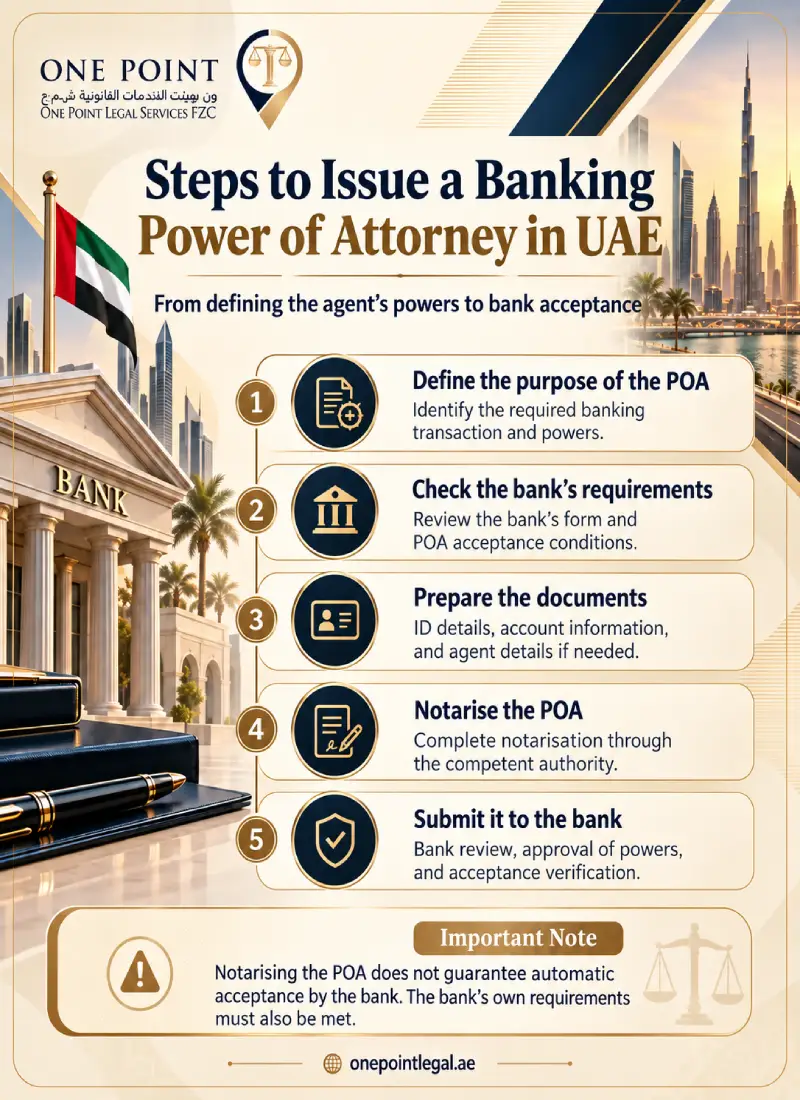
The process begins by identifying the transaction and checking the bank’s requirements. The POA is then drafted, notarised and submitted to the bank for acceptance.
The main steps are:
- Contact the bank: Confirm whether the proposed POA is acceptable and obtain any required forms or wording.
- Define the authorised powers: Identify whether the agent will collect documents, withdraw funds, manage an account or carry out particular transfers.
- Collect the documents: Prepare the principal’s, agent’s, account’s or company’s relevant information.
- Draft the POA: Clearly specify the powers, restrictions and duration, where applicable.
- Review the wording: Ensure the document does not grant unintended authority.
- Notarise the POA: Complete the procedure before the competent authority.
- Submit it to the bank: Allow the bank to verify the document and complete its agent authorisation procedures.
The UAE Ministry of Justice provides a Writing and Authentication of Contracts and Deeds service, which includes electronic applications using UAE Pass, selecting a digital POA, paying the applicable fees, signing and receiving the document electronically, subject to the service’s conditions and jurisdiction.
Local notarisation procedures may differ from one emirate to another.
One Point Legal Services also provides assistance with Notary Public Services in the UAE, including the preparation and coordination of Powers of Attorney through the relevant authorities.
What Should You Check Before Notarising a Banking POA?
To reduce the risk of preparing a POA that the bank cannot accept, verify the following:
| Item | Question to confirm |
|---|---|
| POA form | Does the bank require a specific template? |
| Account details | Must the account number or type be included? |
| Agent’s powers | Does the wording cover the intended transaction? |
| Monetary limits | Will the bank accept a withdrawal or transfer limit? |
| Principal’s attendance | Does the bank require direct verification? |
| Notarisation | Does the bank accept the proposed method of notarisation? |
| Revocation | How must the bank be informed when the authority ends? |
Commercial Bank of Dubai publishes different banking POA forms and sets out its own requirements for verifying a POA before acceptance.
These are the published procedures of that particular bank. They do not mean that every UAE bank follows the same forms or verification methods.
Can a Banking Power of Attorney Be Issued Outside the UAE?
A Banking Power of Attorney may be executed outside the UAE for use at a UAE bank, provided it meets the applicable notarisation and attestation requirements and is accepted by the bank.
The document may be issued before a competent authority in the country where the principal resides or through an available consular procedure, depending on the circumstances.
The process may involve:
- Obtaining the UAE bank’s required wording and acceptance conditions.
- Preparing the POA and specifying the transactions and powers.
- Notarising the document before the competent authority in the issuing country.
- Completing the required attestations in that country.
- Obtaining attestation through the appropriate UAE embassy or consulate, where required.
- Completing UAE Ministry of Foreign Affairs attestation if applicable.
- Providing a certified legal translation when necessary.
- Submitting the document to the bank for verification and approval.
The UAE Ministry of Foreign Affairs explains that the attestation process for documents issued abroad depends on the issuing country, document type and available procedures at the relevant UAE diplomatic mission.
Some UAE missions may offer electronic or digital procedures subject to their conditions.
It is preferable to obtain the bank’s preliminary approval of the proposed wording before completing overseas attestations. A material change to the document may otherwise require it to be redrafted and notarised again.
MOFA attestation alone should not be assumed to guarantee acceptance by the UAE bank.
Why Might a UAE Bank Reject a Banking Power of Attorney?
A bank may reject a banking POA or request additional information even if the document has been notarised.
Common reasons include:
- Unclear powers: The wording is too broad or does not specify the intended transaction.
- Missing express authority: The agent requests a withdrawal even though the POA only permits collecting documents.
- Failure to use the required form: The bank requires specific wording or a particular template.
- Inconsistent details: Information differs between the POA, identity documents and bank records.
- Incomplete attestations: An overseas POA lacks required legalisation.
- Inability to verify the POA: The document does not satisfy the bank’s authentication procedure.
- Insufficient corporate authority: The person issuing the POA for a company has not established their signing powers.
- Account-specific conditions: Additional approvals or joint signatures are required.
Banking compliance and customer due diligence procedures may also affect whether a particular transaction can proceed.
How Can You Reduce the Risk of Rejection?
Before notarisation, obtain the bank’s document checklist, verify the parties’ details and describe the permitted transactions clearly rather than relying on vague general wording.
Ask the bank specifically whether the proposed authority is sufficient, what form of notarisation is acceptable and how the bank will verify the document.
Account passwords, online banking credentials and one-time verification codes should not be shared with an agent as a substitute for the bank’s formal authorisation procedures.
How Can You Limit Banking POA Powers Safely?
Carefully defining the agent’s authority can reduce the risk of misuse or transactions beyond the principal’s intentions.
Consider the following safeguards:
- Specify banks and accounts: Restrict the authority to designated accounts where appropriate.
- Define transactions: Distinguish between obtaining information, managing accounts, withdrawing funds and transferring money.
- Set monetary limits: Where suitable and supported by the bank’s procedures.
- Specify a duration: Particularly if the POA is intended for one transaction or a temporary purpose.
- Exclude sensitive powers: Such as borrowing, mortgaging assets or providing guarantees unless expressly intended.
- Control sub-delegation: Clarify whether the agent may appoint another person, subject to the law and the POA’s wording.
- Monitor transactions: Review account activity and ensure the agent remains within the authorised scope.
Restrictions should be clear, legally appropriate and capable of implementation by the bank.
An effective Banking POA is not necessarily the one granting the widest possible powers. It is the one that permits the intended transaction without unnecessary authority.
Revoking a Banking Power of Attorney in the UAE
A Banking Power of Attorney may terminate under the statutory grounds for the end of an agency. The principal may also be entitled to revoke it or restrict the agent’s powers, subject to the exceptions established by law.
Article 897 of the UAE Civil Transactions Law sets out grounds for termination, including:
- Completion of the authorised task.
- Expiry of the specified term.
- Death or loss of legal capacity of the principal, subject to the applicable legal provisions and exceptions.
- Death or loss of legal capacity of the agent, with consideration for any duties necessary to protect the principal’s interests.
Article 898 permits the principal to remove the agent or restrict their authority, subject to the limitations applicable where third-party rights are involved or the agency has been granted in the agent’s interest.
Steps to Revoke a Banking POA
When the principal intends to terminate the authorisation, the following steps should be considered:
- Review the POA: Determine whether it may be terminated and whether any third-party rights are involved.
- Complete the required revocation procedure: Through the competent notarisation authority where applicable.
- Notify the bank formally: Provide the documents required to establish the revocation.
- Update account permissions: Ask the bank to remove or amend the agent’s operating authority.
- Obtain confirmation: Verify that the bank has processed the revocation and updated its records.
Revoking a POA through a notary should not be assumed to update automatically the records of every bank where the document has been presented.
It may also be necessary to review transactions previously carried out by the agent and any rights acquired by third parties before the authority was terminated.
How One Point Assists With Banking Powers of Attorney
Preparing a Banking Power of Attorney in UAE may involve reviewing legal powers, collecting documents and coordinating notarisation, particularly where the authority relates to financial transactions, company accounts or a POA executed abroad.
Through its Notary Public Services, One Point Legal Services can assist with understanding the requirements and coordinating the appropriate documentation process within its available services.
Assistance may include:
- Reviewing the purpose of the authorisation and the intended banking transaction.
- Identifying the powers that should be included or excluded.
- Reviewing the principal’s and agent’s information and supporting documents.
- Coordinating POA preparation and notarisation through the applicable channels.
- Explaining the attestation requirements for POAs issued outside the UAE.
- Reviewing the steps needed to amend or revoke an existing POA.
For company-related matters involving contractual authority or financial commitments, the firm’s Corporate Legal Services may also assist with reviewing relevant contracts and agreements.
If you need to prepare a Banking Power of Attorney or review an existing authorisation, contact One Point Legal Services and provide the bank’s name, the intended transaction and the powers you wish to delegate.
The bank remains responsible for deciding whether to accept the POA and authorise the requested transactions.
Frequently Asked Questions About Banking Powers of Attorney
Do UAE Banks Accept a General Power of Attorney?
A UAE bank may accept certain powers contained in a General Power of Attorney if the wording is legally sufficient and satisfies its requirements. However, a general POA does not automatically authorise all financial transactions. Articles 870 and 871 of the UAE Civil Transactions Law govern the scope of special and general agencies. The necessary banking powers should therefore be confirmed before notarisation.
Can I Issue a Banking Power of Attorney Online in the UAE?
Yes. Electronic services are available for preparing and notarising certain Powers of Attorney through the UAE Ministry of Justice and other competent notarisation authorities, depending on the emirate and document type. Procedures may include UAE Pass authentication, online submission and electronic signing. However, electronic notarisation does not guarantee bank acceptance, as the bank must still verify the document and the agent's authority.
How Much Does a Banking Power of Attorney Cost in the UAE?
The cost depends on the notarisation authority, emirate, type of POA and services required. The UAE Ministry of Justice lists a fee of AED 100 for its specified Writing and Authentication of Contracts and Deeds service, but this is not a uniform fee for every banking POA in the UAE. Additional signature, translation or overseas attestation charges may apply. Applicants should check the final amount with the competent authority before payment.
Can an Agent Withdraw All the Money From a Bank Account?
That depends on the powers granted in the POA and the bank's applicable conditions. An unrestricted withdrawal authority may give the agent broader powers than the principal intended. It is therefore advisable to identify the relevant accounts, permitted transactions and any appropriate monetary limits, while confirming that the bank can apply the restrictions.
Can a Banking POA Be Issued for Someone Outside the UAE?
A POA may appoint an agent located outside the UAE, or the document itself may be executed abroad. Its use at a UAE bank remains subject to the relevant notarisation, attestation and identity verification requirements. The bank may require the authorised person to attend or complete additional procedures before accessing the account. Applicants should confirm these requirements before issuing the document.
Can One Banking POA Be Used at More Than One Bank?
A single POA may authorise dealings with several banks if that scope is intended and legally permissible. However, each bank applies its own acceptance requirements. One institution may require specific account details, while another may request its own form or verification procedure. It is therefore advisable to check the requirements of every bank concerned before relying on one POA for multiple accounts.
Can Someone Open a Bank Account for Another Person Under a POA?
A bank may allow an agent to submit an account-opening application and sign certain documents if the POA grants the relevant authority. However, the bank must still carry out customer identification and verification procedures. It may require the principal to attend, communicate directly or provide additional documents. A POA alone does not guarantee that an account will be opened.
Can a Banking Power of Attorney Be Revoked After Notarisation?
A Banking Power of Attorney may be terminated or the agent removed in accordance with the UAE Civil Transactions Law, subject to restrictions where third-party rights or the agent's interests are involved. The principal should complete any required formal revocation procedure, notify the bank and request an update to the authorised signatories or account permissions. The bank may need to verify the revocation before amending its records.
Conclusion
A Banking Power of Attorney in UAE allows an authorised person to carry out specified banking transactions on behalf of another party. However, its effective use depends on clearly defined powers, compliance with the legal requirements for agency, proper notarisation and acceptance by the relevant bank.
To avoid rejection or granting unintended financial authority, the principal should check the bank’s requirements before preparing the document and carefully define the scope, duration and restrictions of the authorisation.
One Point Legal Services can assist with understanding the requirements and identifying the appropriate preparation and notarisation process based on the circumstances of the transaction.
Official Legal and Regulatory Sources
- UAE Legislation – Federal Decree-Law No. 25 of 2025 Promulgating the Civil Transactions Law.
- UAE Ministry of Justice – Writing and Authentication of Contracts and Deeds.
- Central Bank of the UAE – Natural Persons Acting on Behalf of the Customer.
- Commercial Bank of Dubai – Power of Attorney Forms and Requirements.
- UAE Ministry of Foreign Affairs – Documents Attestation.
Last content and source review: 11 October 2026.
Disclaimer: This article provides general legal information and does not constitute individual legal advice or guarantee that any bank will accept a Power of Attorney. Agency, notarisation and banking procedures remain subject to applicable laws, competent authority requirements and the circumstances of each transaction.
