
When Do You Need a Divorce Legal Consultation in the UAE?
A divorce legal consultation is important when either spouse needs to understand their rights and obligations before ending the marriage, signing an agreement, or initiating legal proceedings.
Situations that may require professional legal advice include:
- Disagreements over divorce: To identify the available legal procedures and the requirements applicable to each option.
- Disputes regarding alimony or maintenance: To understand potential financial entitlements and the factors affecting their assessment.
- Child custody disputes: To clarify custody, visitation, and guardianship rules under the applicable law.
- Divorce by mutual agreement: To review the proposed settlement and its legal consequences before approval.
- Marriage concluded outside the UAE: To determine the applicable law and documentation requirements.
- Existing court judgments or agreements: To assess their effects on subsequent rights and proceedings.
- Need for court representation: To review the required documentation and arrange contact with a licensed lawyer.
Seeking professional advice does not necessarily mean that divorce is the only appropriate option. Rather, it helps assess the available legal choices and their potential consequences before a decision is made.
Should You Seek Legal Advice Before Agreeing to Divorce?
Yes. It is advisable to obtain a legal review before signing a divorce settlement, particularly when it includes arrangements concerning children, financial obligations, or the waiver of certain rights.
Such agreements may create long-term obligations. Their provisions must also comply with mandatory legal rules and must not undermine children’s rights protected by law.
A legal review helps ensure that the obligations are clearly defined and can be implemented under the applicable legal framework.
What Does a Divorce Legal Consultation Include?
A specialized divorce legal consultation involves assessing the family’s legal circumstances, identifying the applicable legislation, reviewing rights and documents, and explaining the available options before any action is taken.
The scope of the consultation depends on the nature of the case but may include:
- Determining the applicable law: Reviewing the spouses’ circumstances to identify the legal framework governing the divorce and its consequences.
- Assessing legal options: Explaining the differences between divorce by agreement, judicial divorce, and specific civil divorce procedures.
- Reviewing financial rights: Examining maintenance, potential entitlements, and financial obligations in light of the case and the applicable law.
- Evaluating matters involving children: Clarifying custody, visitation, maintenance, and guardianship issues.
- Reviewing documentation: Identifying available documents and those that may need to be obtained.
- Explaining the next steps: Determining whether the circumstances require a settlement, formal proceedings, or assistance from a licensed lawyer.
General information cannot replace an assessment of an individual case. Factors such as the spouses’ residence, an existing judgment, or their nationalities may affect the appropriate legal procedure.
What Documents Should You Prepare Before a Divorce Consultation?
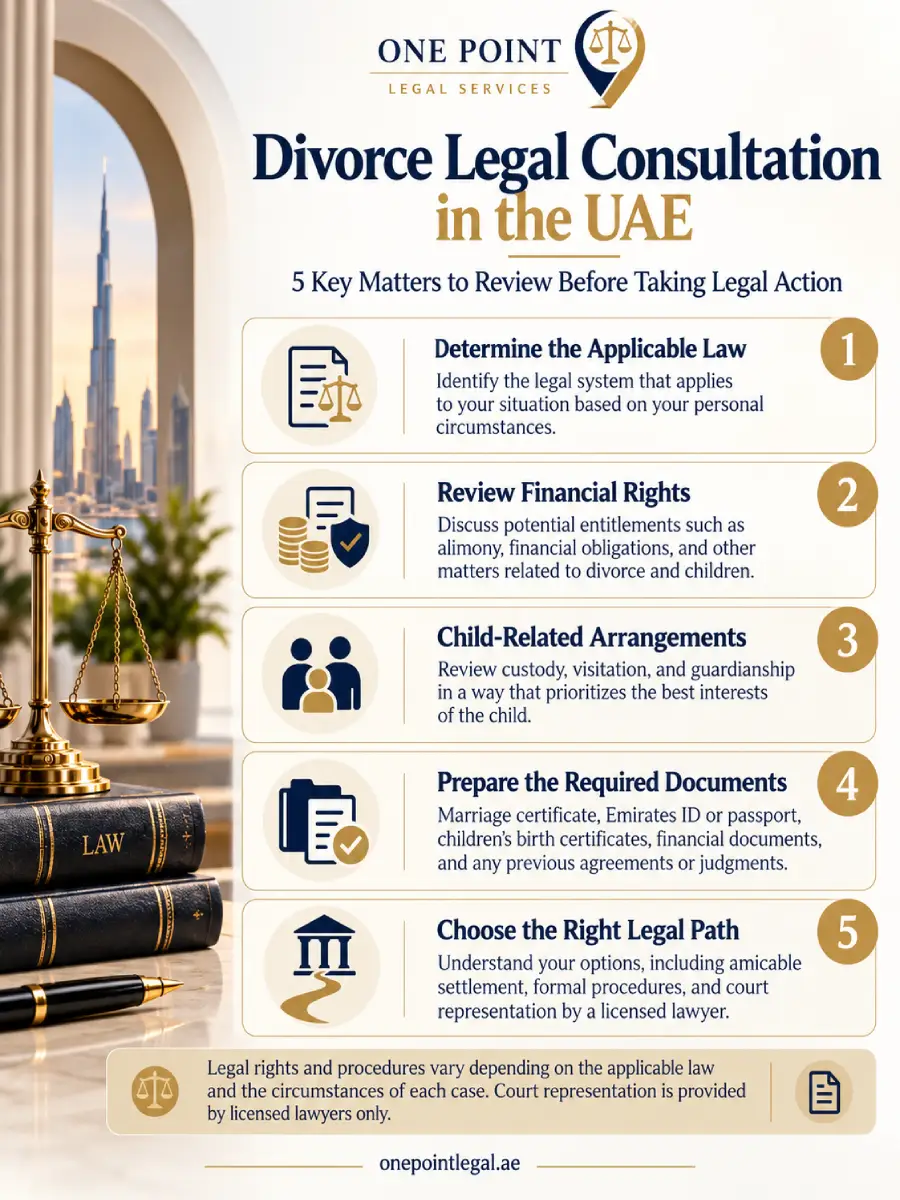
It is advisable to prepare the essential documents before the consultation, although it may not be necessary to provide every document required for court proceedings during the initial meeting.
- Marriage certificate: To verify the parties’ details, where the marriage was concluded, and any recorded conditions.
- Emirates ID or passport: To establish the spouses’ identities, nationalities, and residency information.
- Children’s birth certificates: Where the case involves custody or child maintenance.
- Financial documents: Such as proof of income or financial obligations when these are disputed.
- Previous agreements and court judgments: If the parties have previously entered into a settlement or initiated legal proceedings.
- Relevant documents and evidence: Depending on the dispute, while ensuring that evidence has been obtained and used lawfully.
If the marriage certificate or another essential document was issued outside the UAE, attestation or translation may be required according to the competent authority’s requirements.
You can review One Point’s document attestation services when preparing foreign documents for official use in the UAE.
Do you need clarification about your rights and divorce procedures in the UAE? The One Point Legal Services team can help organize your request, identify the required documents, and coordinate contact with a licensed legal professional according to your circumstances.
Which Law Governs Divorce in the UAE?
The law governing divorce in the UAE depends on the nature of the marital relationship, the legal status of the parties, and the rules concerning the scope of application, jurisdiction, and choice of law. Religion alone does not determine the applicable legal framework.
Two important pieces of legislation are Federal Decree-Law No. 41 of 2024 on Personal Status and Federal Decree-Law No. 41 of 2022 on Civil Personal Status.
Divorce Under Federal Decree-Law No. 41 of 2024
Federal Decree-Law No. 41 of 2024 regulates marriage, divorce, khula, judicial separation, maintenance, and child custody within its scope of application.
Article 1 establishes rules regarding its application to UAE nationals and non-nationals, subject to the provisions concerning non-Muslims and the circumstances in which another law may apply.
The law came into force on 15 April 2025. Therefore, cases falling within its scope should be assessed under its current provisions, taking into account the relevant transitional rules.
Civil Divorce Under Federal Decree-Law No. 41 of 2022
Federal Decree-Law No. 41 of 2022 on Civil Personal Status regulates certain matters relating to marriage, divorce, and family rights for persons and situations covered by its provisions.
Under Articles 7 and 8, either spouse subject to this law may request a divorce without having to prove harm or attribute fault to the other spouse. The divorce is granted by a court judgment after the prescribed procedures have been fulfilled, including notification of the other party.
Cabinet Resolution No. 122 of 2023 sets out detailed provisions for implementing the civil personal status framework.
Additional local rules and procedures may also apply depending on the emirate and the court with jurisdiction.
What Are the Differences Between the Two Divorce Systems?
| Comparison | Personal Status Law 2024 | Civil Personal Status Law 2022 |
|---|---|---|
| Scope of application | Subject to Article 1 and the applicable choice-of-law rules | Applies to persons and situations covered by the civil system |
| Ways to end a marriage | Divorce, khula, judicial separation, and other procedures subject to their respective conditions | Divorce may be requested without proving harm, in accordance with the law |
| Family guidance | May be required depending on the dispute, subject to exceptions | Divorce cases governed by this law are exempt from referral to family guidance committees |
| Child custody | Determined according to custody requirements, arrangements, and the child’s best interests | Contains specific provisions on joint custody and the child’s best interests |
| Financial rights | Depend on the type of divorce, entitlement conditions, and applicable provisions | Governed by the provisions concerning financial claims and rights arising from civil divorce |
This comparison does not mean that every non-Muslim couple automatically follows the same divorce procedure. Jurisdiction and the applicable law must be established before determining the appropriate process.
What Rights Should Be Reviewed During Divorce?
Reviewing divorce-related rights involves identifying potential financial entitlements, family obligations, and matters concerning children, while applying the legal provisions relevant to the type of divorce and the governing law.
Alimony, Maintenance, and Financial Entitlements
A consultation may address spousal maintenance, dowry (mahr), deferred dowry, maintenance during the waiting period (iddah), or other financial rights, depending on the applicable legal framework and the circumstances of the case.
Not all these entitlements arise automatically in every divorce. Eligibility depends on the type of proceedings, the legal grounds, and the provisions governing the claim.
In cases governed by Federal Decree-Law No. 41 of 2022 on Civil Personal Status, financial claims following divorce are subject to specific rules, including Article 9 and the factors considered when assessing financial entitlements.
Separate financial obligations, such as debts, contracts, and independent agreements, should also be reviewed. Ending the marriage does not automatically extinguish these obligations.
Child Custody and Visitation
Custody rules vary depending on the applicable law. Under the civil personal status system, specific provisions regulate joint custody, including the circumstances in which it may be modified or terminated.
Federal Decree-Law No. 41 of 2024 establishes separate rules governing custody eligibility, requirements, and arrangements.
In all cases, the child’s best interests are a central consideration when determining matters relating to care and custody.
Divorce should not be assumed to give one parent every decision-making right concerning the children or automatically eliminate the other parent’s rights.
Child Maintenance and Related Expenses
Financial obligations toward children may include living expenses, education, healthcare, and housing. These obligations are determined under the applicable law and the circumstances relevant to calculating maintenance.
It is important to distinguish between the spouses’ financial rights and children’s independent rights. Child maintenance should not be treated as an entitlement that can simply be waived in exchange for agreeing to a divorce.
Housing and Jointly Held Property
A divorce consultation may also require reviewing the family home, property ownership, bank accounts, and joint financial obligations.
Divorce does not automatically result in all assets being divided equally or transferred to the other spouse. Ownership rights and financial claims must be assessed according to the relevant contracts, documents, and applicable law.
What Are the Divorce Procedures in the UAE?
Divorce procedures depend on the applicable law, the type of application, and the competent court. Some family disputes may begin with family guidance and reconciliation, while other cases may proceed directly to court.
1. Determine the Applicable Law and Type of Application
The process begins by reviewing the marriage certificate, the parties’ legal status, nationalities, religions, and places of residence to determine whether the case involves divorce by agreement, judicial separation, or civil divorce.
This assessment affects jurisdiction, the applicable conditions, and the rights requiring review.
2. Prepare the Required Documents
Relevant documents are collected, including the marriage certificate, identification documents, records concerning children, previous agreements, and applicable financial documents.
Documents issued outside the UAE may require legal translation or attestation, depending on the competent authority’s requirements.
3. Family Guidance and Reconciliation, Where Applicable
Certain family disputes may be referred to family guidance and reconciliation services in an attempt to reach a settlement under the prescribed procedures.
However, some cases are exempt. Article 3 of Federal Decree-Law No. 41 of 2022 excludes divorce cases governed by that law from referral to family guidance committees.
Accordingly, family guidance should not be described as mandatory for every divorce case in the UAE.
4. Submit the Application to the Competent Court
Where court proceedings are necessary, the application is submitted through the approved judicial channels in accordance with jurisdiction, documentation, and service requirements.
The application may concern the termination of marriage, confirmation of a divorce, financial entitlements, or matters involving children.
5. Court Review and Decision
The court examines the facts, applications, and supporting documents under the applicable substantive and procedural laws. Hearings or additional measures may be required depending on the nature of the dispute.
Where legal representation is required, court representation and advocacy are carried out by a duly licensed lawyer, subject to the applicable power-of-attorney and judicial requirements.
What Is the Difference Between Divorce Taking Effect and Its Court Documentation?
Federal Decree-Law No. 41 of 2024 distinguishes between the occurrence of divorce and its official documentation in cases governed by its provisions.
Under Article 58, the husband must document the divorce before the competent court within a maximum of 15 days from the date it occurs, without prejudice to the wife’s right to bring proceedings to establish the divorce.
If the husband fails to document the divorce within the prescribed period without an excuse accepted by the court, the wife may be entitled to compensation under the article, equivalent to maintenance for the period from the divorce until its documentation.
By contrast, divorce governed by the Civil Personal Status Law is granted through a court judgment under its own procedures. Article 58 of the 2024 law should not automatically be applied to civil divorce cases.
The Official UAE Government Portal’s guidance on divorce provides further information about the relevant procedures and documentation requirements.
Legal Consultation vs. Family Guidance vs. Court Representation
Legal consultation, family guidance, and court representation are different services in terms of their purpose and the professionals or authorities responsible for them. Depending on the circumstances, a person may need one or several of these services.
| Service | Purpose | Responsible Professional or Authority |
|---|---|---|
| Legal consultation | Assessing rights, legal options, and procedures | A professional legally authorized to provide legal advice |
| Family guidance and reconciliation | Attempting to resolve eligible family disputes amicably | The competent official authority |
| Document and procedure coordination | Preparing documentation, requirements, and administrative follow-up | A service provider acting within its licensed activities |
| Court representation | Conducting court proceedings and advocacy on behalf of a client | A duly licensed lawyer |
An initial consultation does not replace formal legal proceedings. Likewise, contacting a legal services office does not itself authorize that office to undertake court representation requiring a separate professional licence.
How One Point Legal Services Assists With Divorce-Related Matters
One Point Legal Services assists individuals in organizing requests for legal services relating to divorce and personal status matters. This may include identifying the nature of an inquiry, preparing the necessary documents, coordinating specialized consultations, and following up on administrative requirements according to each case.
The firm’s role may include:
- Organizing the legal request: Identifying the nature of the inquiry and the matters requiring professional legal review.
- Preparing documents: Assisting with identifying and organizing the documents required for the relevant procedure.
- Coordinating legal consultations: Arranging a case review with an appropriately licensed legal professional when required.
- Administrative support: Following up on administrative and coordination matters within the scope of the firm’s licensed services.
- Coordinating court representation: Where court proceedings are necessary, representation and advocacy are undertaken by duly licensed lawyers in accordance with legal requirements.
Clients may therefore begin their inquiry through One Point, while professional and judicial activities requiring specific authorization are handled by legally qualified and authorized professionals.
For more information, visit One Point Legal Services to review the available services and contact options.
Common Mistakes to Avoid Before Starting Divorce Proceedings
Certain early decisions can complicate a dispute or affect financial and family rights. Legal matters should therefore be reviewed before signing agreements or starting formal proceedings.
- Signing an agreement without reviewing its terms: Particularly where it involves waiving claims or accepting financial obligations.
- Relying on outdated legislation: Without checking the current Personal Status Law and its scope of application.
- Assuming every divorce case follows the same process: Despite the differences between applicable legal frameworks.
- Failing to retain financial documentation: Especially where maintenance or financial claims are disputed.
- Confusing spouses’ rights with children’s rights: Children’s entitlements are subject to separate legal protections.
- Using recordings or communications unlawfully: This may create separate legal issues.
- Ignoring ongoing proceedings or legal deadlines: Without consulting an appropriately qualified professional.
- Relying on promises of specific outcomes: Court decisions and the duration of proceedings cannot be guaranteed before the case is assessed.
Frequently Asked Questions About Divorce Legal Consultation in the UAE
When Should I Seek a Divorce Legal Consultation?
A divorce legal consultation is important before initiating proceedings or signing a separation agreement, particularly when disputes concern alimony, child custody, or financial rights. A licensed professional can help identify the applicable law, available legal options, and required documents. A consultation is also important when an existing court judgment, ongoing dispute, or need for court representation affects the case.
How Much Does a Divorce Legal Consultation Cost in the UAE?
The cost of a divorce legal consultation varies according to the nature and complexity of the case, the consultation's duration, the documents requiring review, and the professional providing the advice. There is no single fee applicable to every consultation. You may contact One Point Legal Services to explain your inquiry and obtain information about the scope and cost of available services before proceeding.
Can You File for Divorce in the UAE Without Proving Harm?
Yes, in cases governed by Federal Decree-Law No. 41 of 2022 on Civil Personal Status, either spouse may request a divorce without proving harm or attributing fault to the other party, under Articles 7 and 8. Other divorce and judicial separation applications governed by Federal Decree-Law No. 41 of 2024 have different requirements depending on the type of proceedings. The applicable law must therefore be identified first.
Is Family Guidance Mandatory Before Divorce in the UAE?
Not in every case. Some family disputes may require referral to family guidance and reconciliation, but legal exceptions apply. Divorce proceedings governed by Federal Decree-Law No. 41 of 2022 on Civil Personal Status are exempt from referral to family guidance committees under Article 3. The correct procedure depends on the type of case, the competent court, and the applicable law.
What Documents Are Required for a Divorce Consultation?
It is advisable to prepare the marriage certificate, Emirates ID or passport, children's birth certificates where applicable, previous agreements or court judgments, and relevant financial records. Not every document must be available at the initial inquiry. The legal professional can identify any additional requirements after reviewing the circumstances. Foreign-issued documents may require translation or attestation before they are used officially.
Can Spouses Agree on Divorce, Maintenance, and Custody Without Filing a Lawsuit?
Spouses may agree on certain family matters according to the applicable legal rules and procedures. However, the validity, enforceability, and approval requirements of any agreement must be considered. A settlement must not violate mandatory legal provisions or undermine children's protected rights. Formal procedures may still be necessary to establish or document the divorce or approve an agreement, depending on the circumstances.
How Long Does Divorce Take in the UAE?
The duration depends on the type of application, the applicable law, and whether the spouses have reached an agreement or are involved in a dispute requiring judicial review. Service of documents, evidence, and applications concerning children may also affect the timeline. No single timeframe can be guaranteed for all divorce cases, and the circumstances must be assessed before an estimate can be given.
Can Foreign Residents File for Divorce in UAE Courts?
Foreign residents may seek divorce before UAE courts when the relevant jurisdictional rules and legal requirements are satisfied. The procedure may differ depending on the spouses' nationalities, religions, places of residence, the nature of the marriage, and the applicable law. Their circumstances should therefore be reviewed before selecting the court or type of application, especially if the marriage took place outside the UAE.
Does One Point Provide Court Representation in Divorce Cases?
One Point Legal Services assists with organizing requirements and coordinating legal services related to the case. Where court representation is required, it is handled by duly licensed lawyers in accordance with the applicable power-of-attorney and judicial requirements. Professional legal activities and court advocacy requiring special authorization remain the responsibility of persons legally licensed to perform them.
Conclusion
A Divorce Legal Consultation in the UAE can help clarify legal rights and procedures before making decisions affecting family relationships and financial obligations, particularly where children, shared commitments, or questions about the applicable law are involved.
Identifying the correct legal framework, preparing relevant documents, and reviewing agreements before signing them are important steps toward managing the matter in an informed and organized manner.
You may contact One Point Legal Services to inquire about available services and coordinate a case review with a licensed legal professional. Where court representation is necessary, it is undertaken by duly licensed lawyers.
Official Legal Sources and References
- UAE Legislation Portal – Federal Decree-Law No. 41 of 2024 on Personal Status.
- UAE Legislation Portal – Federal Decree-Law No. 41 of 2022 on Civil Personal Status.
- UAE Legislation Portal – Cabinet Resolution No. 122 of 2023, Implementing Regulation of the Civil Personal Status Law.
- Official UAE Government Portal – Divorce in the UAE.
- Abu Dhabi Judicial Department – Family Guidance and Reconciliation.
Legal Disclaimer: This guide provides general information about divorce procedures in the United Arab Emirates and does not constitute legal advice tailored to an individual case. Rights and procedures depend on the circumstances, jurisdiction, and applicable law. You should consult an appropriately licensed legal professional before taking any action affecting your rights or obligations.
