

To obtain a power of attorney at the Egyptian Consulate in Dubai, you need an original valid Egyptian passport or national ID card, two copies of your identification document, and a completed power of attorney form. You must also attend the consulate to sign the document before the authorized official. The published consular fees are AED 180 for an ordinary power of attorney and AED 480 for a commercial power of attorney.
Additional documents depend on the purpose of the authorization. This guide covers the required documents, application steps, fees, and use of the document in Egypt, as well as the difference between a consular power of attorney and one notarized in the UAE.
Documents Required for a Power of Attorney at the Egyptian Consulate in Dubai
The Egyptian Consulate in Dubai requires an original valid Egyptian identification document and a completed power of attorney form. The Egyptian Ministry of Foreign Affairs also specifies two copies of the identification document and any additional supporting documents applicable to the transaction.
The basic requirements are:
| Document | Requirement |
|---|---|
| Egyptian passport | Original, valid passport |
| Or Egyptian national ID card | Original, valid national ID card |
| Identification copies | Two copies of the identification document presented |
| Power of attorney form | Completed form corresponding to the intended authorization |
| Proof of legal capacity or authority | When acting on behalf of another person, representing a company, or acting as a guardian |
| Ownership documents | Where required for the transaction and the type of power of attorney |
For powers of attorney, the consulate accepts a valid Egyptian passport or Egyptian national ID card as identification; other identification documents are not accepted as substitutes. Review the Egyptian Consulate in Dubai’s official requirements for powers of attorney and declarations before attending.
Additional Documents When Acting in a Legal Capacity
If you are granting a power of attorney as an agent for another person, a company representative, or a guardian, you must provide evidence of that authority. Depending on the circumstances, this may include the original underlying power of attorney, a commercial registration document, or a court judgment.
According to the Egyptian Ministry of Foreign Affairs, proof of authority must be authenticated by Egypt’s Ministry of Foreign Affairs or the foreign ministry in the relevant country, depending on where the document was issued.
Documents for a Power of Attorney to Sell a Car in Egypt
The required supporting documents for a vehicle-sale power of attorney depend on how ownership is established:
- If the vehicle is licensed in the applicant’s name, provide the vehicle registration licence.
- If the vehicle was purchased under a sale agreement executed at the Egyptian Real Estate Registration and Notarization Department, provide the sale agreement authenticated by the Egyptian Ministry of Foreign Affairs, together with a copy of the vehicle licence.
- If the vehicle was purchased under a previous power of attorney, provide the original power of attorney authenticated by the Egyptian Ministry of Foreign Affairs, together with a copy of the vehicle licence.
- If the vehicle licence expired more than three months ago, provide a vehicle information certificate from the relevant traffic authority.
These requirements relate specifically to powers of attorney for vehicle sales and should not automatically be applied to other types of authorization.
Official source: Egyptian Ministry of Foreign Affairs – Powers of Attorney and Declarations.
Power of Attorney Fees at the Egyptian Consulate in Dubai
Fees depend on how the Egyptian Consulate in Dubai classifies the power of attorney. Its published schedule distinguishes ordinary powers of attorney from those involving commercial transactions.
Official published fees. Fees may change, so check the official source before applying.
| Type of power of attorney | Official fee | Collecting authority |
|---|---|---|
| Ordinary power of attorney | AED 180 | Egyptian Consulate in Dubai |
| Commercial power of attorney | AED 480 | Egyptian Consulate in Dubai |
Examples listed in the consulate’s commercial category include transactions involving companies, leasing, shops, pharmacies, shares, bakeries, mills, vehicles, and the sale of multiple vehicles or properties.
Whether a power of attorney is described as general or special does not, by itself, determine its fee classification. The nature of the authorized transactions matters under the consulate’s classification system.
Before submitting your application, confirm the applicable category and fee through the Egyptian Consulate in Dubai’s official power of attorney page.
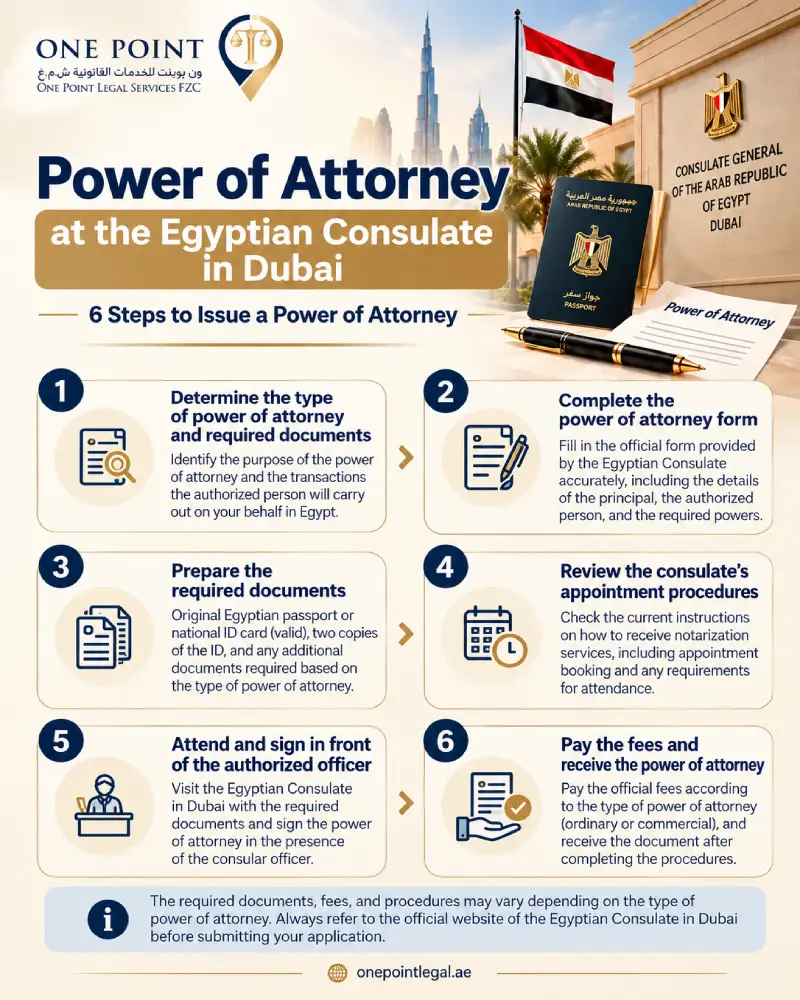
How to Obtain a Power of Attorney at the Egyptian Consulate in Dubai
The process begins by identifying the intended purpose and collecting the parties’ details. You then complete the form, prepare the supporting documents, and attend the consulate to sign before the authorized official.
1. Identify the Type of Power of Attorney and Required Powers
Specify what you want another person to do on your behalf in Egypt, such as handling an administrative matter, managing property, disposing of assets, or representing a company.
It is advisable to check in advance which powers the receiving authority in Egypt requires. This helps avoid drafting an authorization that is broader or narrower than necessary.
2. Complete the Power of Attorney Form
The Egyptian Consulate provides a form for powers of attorney and declarations through its official service page.
Enter the principal’s details, the authorized agent’s details, and the actions being authorized accurately. The principal’s identification details should match the Egyptian identification document used for the application.
The form can be accessed through the consulate’s official powers of attorney page.
3. Prepare the Required Documents
Prepare your original valid Egyptian passport or national ID card, two copies of the identification document, and any additional documents relating to ownership or legal authority.
If supporting documents were issued by an authority requiring authentication, check that the necessary authentication has been completed.
4. Check the Consulate’s Attendance Arrangements
Before visiting the Egyptian Consulate in Dubai, consult its current announcements concerning service hours, the acceptance of power of attorney applications, and any arrangements for attending in person.
Do not assume that an online appointment is mandatory or that the entire process can be completed remotely without checking the procedures in force when you apply.
5. Submit the Application and Sign Before the Authorized Official
Present the completed form and supporting documents to the authorized consular official and sign the power of attorney in that official’s presence.
The Egyptian Ministry of Foreign Affairs states that signing must take place before the authorized official. Once the power of attorney has been issued and received, erasures, amendments, or additions are not permitted.
6. Pay the Fee and Collect the Power of Attorney
Complete the issuance process and pay the applicable fee according to the classification of your application.
On collection, review the parties’ identification details and the powers stated in the document to ensure that they meet the intended purpose in Egypt.
The consulate’s official powers of attorney page does not specify a processing time. Ask the consulate directly when the document can be collected.
Types of Powers of Attorney Available at the Egyptian Consulate in Dubai
The consulate can issue powers of attorney for different purposes. An agent’s authority depends on the wording of the document and the nature of the transaction.
General Power of Attorney
A general power of attorney grants the agent authority within the range of acts specified in the document.
The word “general” does not necessarily authorize every conceivable action. Some transactions may require express or specially worded powers.
Special Power of Attorney
A special power of attorney authorizes a particular transaction or defined set of actions, such as dealing with a government department or completing a specific procedure in Egypt.
The wording should reflect the intended purpose, with sufficiently precise details of the authorized acts.
Powers of Attorney for Selling or Dealing with Property
These documents authorize another person to carry out stated transactions involving real estate, vehicles, or other assets.
Depending on the transaction, proof of ownership or authority may be needed, and fees may differ based on the consulate’s classification.
Commercial Powers of Attorney
Commercial powers of attorney cover transactions classified by the consulate as commercial in nature, including certain company, shop, share, and other business-related matters.
The published fee for this category is AED 480. Confirm the classification for your specific transaction before applying.
How Egyptian Residents in the UAE Can Issue a Power of Attorney for Egypt
Egyptian nationals residing in the UAE can issue a power of attorney from outside Egypt through the appropriate Egyptian consular mission without travelling to Egypt solely to execute the document.
To issue a power of attorney in the UAE for use in Egypt, first identify the purpose of the authorization, prepare valid Egyptian identification and supporting documents, complete the appropriate form, and attend the competent consular mission for signing.
The appropriate mission depends on jurisdiction and the services available. Check its current requirements before visiting.
Notarizing a power of attorney before a UAE notary public for subsequent use in Egypt is a different procedure, involving a different issuing authority and potentially different authentication requirements.
Is Personal Attendance Required?
Yes. The published Egyptian consular instructions require the person granting the power of attorney to sign before the authorized official.
You may prepare the details and form beforehand, but this does not replace the consulate’s identity-verification and signing requirements.
This procedure should not be confused with electronic notarization services available through certain UAE notary authorities. The applicable process depends on the issuing authority and the type of document.
How to Use a Consular Power of Attorney in Egypt
After obtaining a power of attorney from the Egyptian Consulate in Dubai, make sure its wording authorizes the transaction that the agent will undertake in Egypt.
Check the following:
- Parties’ details: Confirm the names and identification information of the principal and agent.
- Scope of authority: Check exactly which acts the agent is authorized to carry out.
- Receiving authority: Confirm the requirements of the relevant Egyptian institution.
- Document submission: Ask whether the original power of attorney or any additional procedure is required.
- Delivery: Arrange to send the original document to the agent in Egypt where necessary.
A power of attorney issued by an Egyptian consular mission is different from one notarized by a UAE authority. Do not assume that both documents follow identical authentication procedures.
For real estate, commercial, and other transactions subject to special requirements, check directly with the competent Egyptian authority to confirm how the power of attorney must be presented and accepted.
Egyptian Consular Power of Attorney vs. UAE Notarized Power of Attorney
A power of attorney issued by the Egyptian Consulate in Dubai differs from one notarized by a UAE notary public in its issuing authority, procedure, and potential requirements for use in Egypt.
| Comparison | Egyptian Consulate in Dubai | UAE Notary Public |
|---|---|---|
| Issuing authority | Egyptian consular authority | Competent UAE notarization authority |
| Procedure | Execution and issuance of an Egyptian consular power of attorney | Notarization under the applicable UAE procedures |
| Identification | Egyptian consular identification requirements | Requirements of the UAE notarization authority |
| Signature | Before the authorized consular official | Under the process approved by the UAE notary authority |
| Fees | According to the consulate’s published fee classification | According to the UAE authority and transaction type |
| Use in Egypt | Subject to the requirements of the receiving Egyptian authority | May require additional authentication depending on the document and intended use |
A consular power of attorney is issued by an Egyptian authority, while a UAE notarized power of attorney is executed within the UAE and may require additional authentication before it is used abroad.
If you need a power of attorney notarized through a UAE authority, see our online power of attorney services in the UAE for the procedures and requirements applicable to electronic notarization. This is separate from issuance by the Egyptian Consulate in Dubai and is not automatically interchangeable with it.
You can also review our UAE notary public services for further information about notarization through the competent UAE authorities.
For documents notarized in the UAE that need authentication for use abroad, our document attestation services and consular attestation services explain the scope of assistance available with attestation arrangements.
Always check the receiving Egyptian authority’s requirements before beginning the authentication process. Obtaining a consular power of attorney and notarizing a UAE power of attorney are not the same procedure.
Need a power of attorney for use in Egypt? The One Point Legal Services team can help you review document requirements and prepare the wording, while explaining the difference between Egyptian consular issuance and UAE notarization.
Ask About Preparing Your Power of Attorney
Or continue reading to understand the requirements and procedures.
Common Mistakes to Avoid When Obtaining a Power of Attorney
Incomplete documents or inaccurate details can result in the need to supplement the application or prepare a new power of attorney, particularly when the stated powers do not match the intended transaction.
- Expired identification: A valid Egyptian passport or national ID card is required.
- Missing proof of authority: Supporting documents may be required if you act on behalf of another person or represent a company.
- Incomplete ownership documents: Additional records may be needed for some vehicle sales or property-related transactions.
- Incorrect agent details: Errors may complicate acceptance by the receiving authority in Egypt.
- Unclear authorized powers: The document should expressly include the actions the agent needs to perform.
- Confusing consular issuance with UAE notarization: The two routes involve different competent authorities and requirements.
Before issuing the document, check the parties’ details, the exact purpose of the authorization, and the requirements of the authority that will receive it.
How One Point Legal Services Can Assist
One Point Legal Services provides support with preparing legal documents and powers of attorney, as well as coordinating notarization and attestation requirements in the UAE.
Depending on the transaction, assistance may include:
- Reviewing the purpose of the power of attorney and the powers to be included.
- Assisting with the wording of the document and the parties’ details.
- Clarifying which supporting documents should be prepared or confirmed with the relevant authority.
- Assisting with UAE notarization and attestation procedures within the company’s service scope.
One Point Legal Services does not itself issue Egyptian consular powers of attorney and does not replace the consulate in verifying identity, witnessing signatures, or issuing consular documents.
Frequently Asked Questions About Powers of Attorney at the Egyptian Consulate in Dubai
What documents do I need for a power of attorney at the Egyptian Consulate in Dubai?
You generally need your original valid Egyptian passport or national ID card, two copies of that identification document, and a completed power of attorney form. Additional supporting documents may be required for specific transactions, such as a car sale, or when you act in a representative or guardianship capacity.
How much does a power of attorney cost at the Egyptian Consulate in Dubai?
The consulate's published fee is AED 180 for an ordinary power of attorney and AED 480 for one classified as commercial. Classification depends on the nature of the authorized transaction, not simply whether the document is general or special. Check the consulate's current official fee schedule before applying.
Can I obtain an Egyptian consular power of attorney online?
You can prepare the form and details in advance, but the published Egyptian Ministry of Foreign Affairs instructions require signing before the authorized official. Do not assume that the entire procedure is available remotely. Confirm current attendance and application arrangements directly with the Egyptian Consulate in Dubai.
Can a power of attorney issued in Dubai be used in Egypt?
A power of attorney issued by the Egyptian Consulate in Dubai is intended for relevant transactions in Egypt, subject to the receiving authority's requirements. Confirm that the wording provides the necessary powers and ask whether the original document or any additional steps are required for your particular transaction.
Is an Egyptian consular power of attorney the same as a UAE notarized power of attorney?
No. An Egyptian consular power of attorney is issued by an Egyptian consular authority, whereas a UAE notarized power of attorney is notarized under UAE procedures. Requirements for using either document in Egypt may differ, including potential authentication steps for a document issued by a UAE authority.
Conclusion
To obtain a power of attorney at the Egyptian Consulate in Dubai, prepare valid Egyptian identification and two copies, complete the appropriate form, identify the required powers, attend the consulate to sign before the authorized official, and pay the applicable fee.
Before issuance, confirm that the wording suits the intended transaction in Egypt and that all supporting documents and any specific requirements of the receiving authority have been addressed.
Official Sources
- Consulate General of the Arab Republic of Egypt in Dubai – Powers of Attorney and Declarations: identification requirements, forms, fee amounts, and classification.
- Egyptian Ministry of Foreign Affairs – Powers of Attorney and Declarations: identity documents, signing, representative capacity, and vehicle-related requirements.
- UAE Ministry of Foreign Affairs: UAE document attestation services and use of documents abroad.
Disclaimer: This article is provided for general information only. It does not constitute legal advice for any individual situation and does not create an attorney-client relationship. Procedures and requirements are subject to the instructions of the competent authorities in force at the time of application.
