

A Litigation Power of Attorney UAE authorises a licensed lawyer to represent a client before the competent courts and judicial authorities, file and pursue claims, and conduct a defence within the powers expressly granted by the power of attorney. Judicial representation must be established in accordance with legal procedures. Certain acts, including settlement, waiver of a right, and admission of a claim, require specific authorisation.
The requirements for issuing a litigation power of attorney vary according to the type of case, the competent judicial authority, and whether the principal is an individual or a company. Some powers of attorney can also be issued electronically, subject to the requirements of the relevant authority.
This guide explains the required documents, the lawyer’s powers, the steps for drafting and notarising the power of attorney, applicable fees, how to appoint a lawyer from outside the UAE, and how to revoke a power of attorney while a case is pending.
Why Is a Litigation Power of Attorney Important in the UAE?
A litigation power of attorney establishes a lawyer’s authority to represent the client before the court and conduct proceedings on the client’s behalf, within the limits of the authorisation and the law.
Article 58 of Federal Decree-Law No. 42 of 2022 Promulgating the Civil Procedure Law requires a representative to establish their authority through an official power of attorney. It also permits an appointment to be made by a declaration recorded in the hearing minutes.
The document helps define the steps the lawyer may take, such as filing a claim, submitting written pleadings, attending hearings, and following up on court proceedings.
However, issuing a power of attorney does not automatically grant every possible authority. Article 61 of the Civil Procedure Law requires specific authorisation for certain acts.
When Do You Need to Appoint a Lawyer?
You may need to issue a litigation power of attorney in situations such as:
- Filing and pursuing civil or commercial proceedings.
- Defending a claim brought before a court.
- Following up on financial claims and contractual disputes.
- Taking appeal or enforcement steps within the scope of the authorisation.
- Representing a company in litigation through a licensed lawyer.
- Taking specific legal steps that require a party to be represented by an authorised agent.
Representation requirements in criminal, personal status, and other matters may differ depending on the applicable legislation, the procedural step, and the competent court.
The purpose of the power of attorney and the stage of the case should therefore be established before its wording is drafted.
What Powers Does a Lawyer Have Under a Litigation Power of Attorney?
A litigation power of attorney enables the lawyer to take the steps necessary to file, pursue, and defend a case. Certain acts that directly affect the client’s rights require specific authorisation.
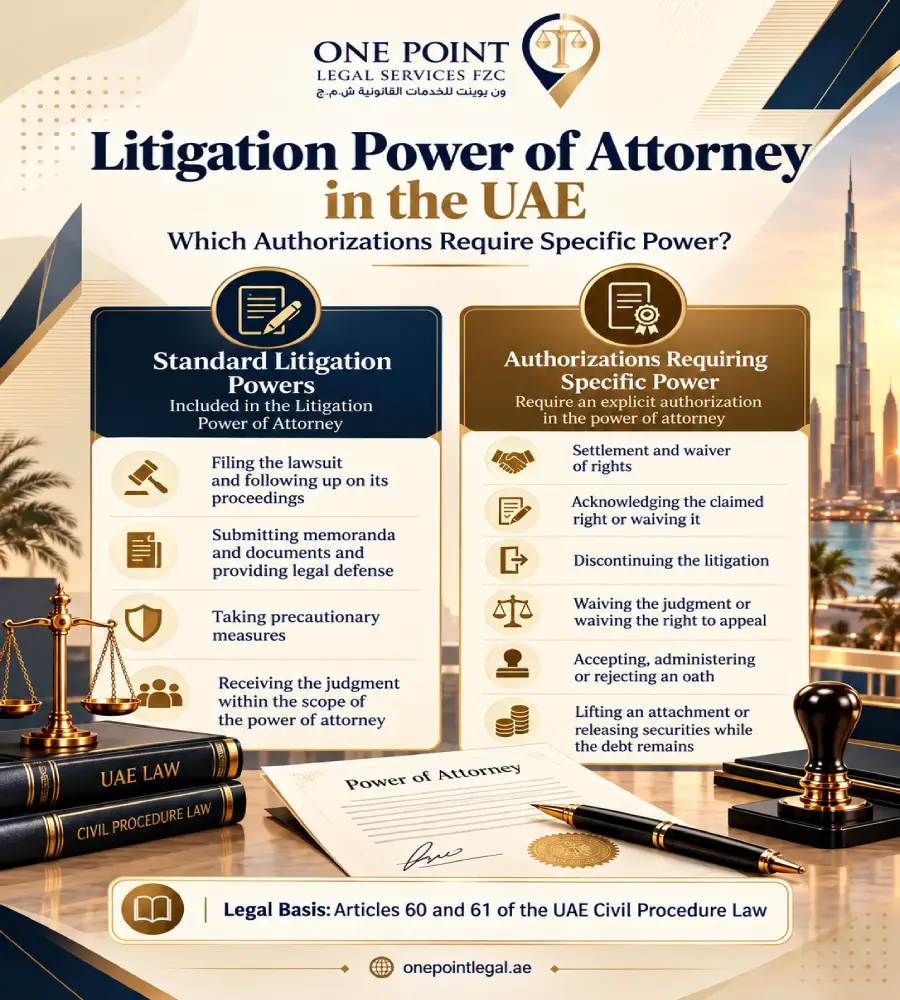
Article 60 of the Civil Procedure Law provides that a litigation power of attorney authorises the representative to perform the acts and procedures necessary to initiate proceedings, pursue and defend the claim, and take precautionary measures until a judgment on the merits is issued and served at the level of litigation for which the representative was appointed.
This does not override the requirement for specific authorisation where the law expressly imposes it.
Article 61 identifies acts that a representative cannot perform without specific authorisation. These include admitting the right claimed, waiving that right, entering into a settlement or arbitration concerning it, and waiving a judgment or a method of appeal.
The following table distinguishes ordinary litigation powers from acts requiring specific authorisation:
| Action | Type of Authorisation |
|---|---|
| Filing and pursuing a case | Within the scope of the litigation power of attorney, subject to the law |
| Submitting pleadings and documents and presenting a defence | Generally falls within ordinary judicial representation |
| Taking precautionary measures | Within the scope of litigation authority under Article 60 |
| Service of the judgment | Within the litigation authority at the level of proceedings covered by the appointment |
| Settling a dispute | Requires specific authorisation |
| Admitting or waiving the right claimed | Requires specific authorisation |
| Accepting, administering, or referring back an oath | Requires specific authorisation |
| Discontinuing proceedings | Requires specific authorisation |
| Waiving a judgment or a right of appeal | Requires specific authorisation |
| Releasing an attachment or relinquishing security while the debt remains outstanding | Requires specific authorisation |
What Is the Difference Between a Special Power of Attorney and Specific Authorisation?
It is important to distinguish between a special power of attorney and specific authorisation. A power of attorney may be limited to a particular case without granting all exceptional powers.
For example, authorising a lawyer to handle a debt recovery case does not automatically entitle that lawyer to waive the amount claimed or settle the dispute.
If the client wants to grant such a power, the power of attorney must clearly and specifically authorise the relevant act.
Which Powers Should You Review Before Signing?
Check whether the power of attorney covers one case or several, and whether the lawyer may undertake enforcement proceedings, file appeals, or receive money and documents on the client’s behalf.
Pay particular attention to the level of court proceedings covered. An appointment limited to one stage should not be assumed to extend automatically to every stage of litigation.
The preferred approach is to grant the powers needed to conduct the case without adding broader powers unrelated to the intended purpose.
Defining a lawyer’s powers is an important step before notarising a litigation power of attorney, particularly when specific authorisation is needed for certain actions. One Point Legal Services can help review the requirements, clarify the necessary powers and documents, and identify the appropriate notarisation process for your matter.
Review Your Litigation Power of Attorney Requirements
Contact us on WhatsApp and tell us the type of case and the relevant judicial authority.
Documents Required for a Litigation Power of Attorney UAE
The documents generally include proof of the principal’s identity, the lawyer’s details, a draft power of attorney, and, where applicable, documents establishing the principal’s legal capacity and authority to issue it.
The final requirements depend on the notarising authority, the type of transaction, and the status of the parties.
Documents Required for Individuals
The basic documents may include:
- A valid Emirates ID or passport, depending on the service requirements.
- Details of the lawyer being appointed.
- A copy of the lawyer’s professional registration card if requested by the competent authority.
- A draft power of attorney specifying the powers granted.
- Case details or the subject of the dispute if necessary to define the authorisation.
The Abu Dhabi Judicial Department’s guide to notarising a special litigation power of attorney identifies the Emirates ID, the instrument to be notarised, and a copy of the lawyer’s registration card where a lawyer is appointed.
Check the current service requirements when applying, as they may vary by authority and procedure.
Documents Required for Companies
Where a company issues the power of attorney, the documents may include:
- A valid trade licence.
- The memorandum and articles of association or other constitutional documents.
- Evidence that the proposed signatory has authority to act for the company.
- A partners’ or board resolution, where required.
- The lawyer’s details and the draft power of attorney.
- Any additional documents requested by the notarising authority.
Being a shareholder or partner does not, by itself, establish authority to appoint a lawyer for the company. The person’s powers must be checked against the company’s legal documents.
Documents issued outside the UAE or in a foreign language may require legal translation or additional attestations, depending on the competent authority’s conditions.
Steps to Issue a Litigation Power of Attorney in the UAE
The process begins by identifying the case and the powers required, drafting the power of attorney, and submitting it for notarisation to the competent authority. The notarised document can then be used to establish judicial representation.
The main steps are:
- Define the purpose: Identify the type of case, competent court, stage of litigation, and actions the lawyer is expected to undertake.
- Verify the lawyer’s details: Check professional registration, licensing, and eligibility to appear before the relevant authority.
- Specify the scope of authority: Distinguish ordinary litigation powers from actions requiring specific authorisation.
- Prepare the draft: Enter the principal’s and lawyer’s details, the powers granted, and the authorities before which the document will be used.
- Submit the notarisation application: Apply through a notary public or the authorised channels of the competent notarising authority.
- Complete identity verification and signing: Follow the approved process, electronically or in person when required.
- Pay the applicable fees and receive the document: Review the notarised instrument and verify its details.
- Establish representation before the court: Submit the power of attorney in accordance with the court’s case-file procedures.
Review the wording before signing, particularly if it includes powers to settle, waive rights, receive payments, or take enforcement steps.
Can You Issue a Litigation Power of Attorney Online?
Yes. Electronic services are available for issuing certain types of powers of attorney in the UAE.
In 2023, the UAE Ministry of Justice announced that powers of attorney for lawyers were among the types of digital powers of attorney introduced through its services.
The Ministry’s service for drafting and authenticating contracts and instruments describes a process involving UAE Pass login, application submission, payment, electronic signing, and receipt of the authenticated document.
However, eligibility for completing the process online depends on the service conditions, the type of power of attorney, the parties’ details, and identity-verification requirements.
For assistance with drafting, reviewing, and coordinating notarisation, see One Point’s online power of attorney service in the UAE.
How to Appoint a Lawyer From Outside the UAE
A litigation power of attorney may be issued from outside the UAE through channels accepted by the relevant authority, either using an eligible online service or by notarising the document abroad and completing the required attestations.
The appropriate route depends on the principal’s country of residence, available identity-verification methods, and the requirements of the court where the power of attorney will be used.
Issuing a Power of Attorney Online From Abroad
A principal outside the country may be able to use an electronic service if they meet the identity, electronic-signature, and notarisation requirements.
However, it should not be assumed that everyone outside the UAE can issue an electronic power of attorney or that a passport alone will satisfy every requirement.
Notarising a Power of Attorney Issued Abroad
It may be necessary to prepare and notarise the document before the competent authority in the principal’s country of residence, then complete the attestations required for its acceptance in the UAE.
Depending on the country of issue and the receiving authority, the process may include authentication by local authorities, the UAE embassy, or the Ministry of Foreign Affairs, together with legal translation where required.
You can consult One Point’s UAE Ministry of Foreign Affairs attestation service for information about the requirements for documents to be used in the UAE.
Before issuing a power of attorney abroad, confirm the requirements of the court or judicial authority to avoid having to amend or re-attest the document.
Litigation Power of Attorney Fees in the UAE
The fees for a litigation power of attorney in the UAE vary according to the notarising authority, the type of instrument, the number of signatures, and the services required. Notarisation fees are separate from lawyer’s fees and court fees.
Additional charges may apply where a private notary public is used, in accordance with the applicable regulations and decisions.
Ministry of Justice Fees for a Lawyer’s Power of Attorney
The UAE Ministry of Justice lists a fee of AED 100 within the scope of its federal service for drafting and authenticating contracts and instruments.
However, applicants should check whether the published fee applies to the particular instrument and procedure at the time of submission.
The amount should not be treated as a uniform fee for every notarising authority in the UAE.
Litigation Power of Attorney Fees in Dubai
Under the fee schedule in Executive Council Resolution No. 72 of 2025, notarising a general or special power of attorney in Dubai costs AED 100 per signature on the power of attorney.
Where notarisation is carried out by a private notary public, Decision No. 312 of 2025 sets a charge of AED 100 per signature on a general or special power of attorney.
The decision also provides for a charge for electronically registering the parties’ details for the services listed in its schedule. Other amounts may apply depending on the transaction.
It is therefore important to distinguish the government notarisation fee from private notary public charges when calculating the total cost.
Do Notarisation Fees Include the Lawyer’s Fees?
No. Three different types of costs should be distinguished:
| Cost Category | What It Covers |
|---|---|
| Power of attorney notarisation fees | Amounts charged by the competent notarising authority |
| Lawyer’s fees | Agreed remuneration for legal advice or representation in court |
| Court fees | Amounts payable for the particular case and judicial procedure |
Other costs, such as legal translation or foreign-document attestation, may also apply where required.
Review the relevant costs before issuing the power of attorney or signing a legal services fee agreement.
Revoking a Litigation Power of Attorney in the UAE and Its Effect on a Case
As a general rule, a principal may revoke a lawyer’s authority or restrict their powers subject to the applicable law. However, revocation does not automatically suspend court proceedings, and procedural or financial consequences may arise depending on the circumstances.
Federal Decree-Law No. 25 of 2025 Promulgating the Civil Transactions Law governs agency, its termination, and the dismissal of an agent. It entered into force on 1 June 2026.
When Can a Lawyer’s Power of Attorney Be Revoked?
Article 898 of the Civil Transactions Law recognises a principal’s right to dismiss an agent or restrict the agent’s powers, subject to limitations where rights of third parties are attached to the agency or where the agency was granted in the agent’s interest.
Article 897 also sets out circumstances in which an agency terminates, including completion of the assigned task or expiry of its specified term, in addition to other circumstances provided by law.
Consider the nature of the power of attorney, the legal services fee agreement, and any rights linked to the appointment before initiating revocation.
Does Dismissing a Lawyer Automatically Suspend the Case?
Dismissal of a lawyer does not automatically stop court proceedings.
Under Article 59 of the Civil Procedure Law, the representative’s resignation or dismissal does not prevent proceedings from continuing in relation to that representative unless the opposing party is notified that a replacement representative has been appointed or that the principal intends to conduct the case personally.
When changing lawyers, the relevant notification procedures and proof of the new appointment should therefore be completed, while continuing to monitor hearing dates and pending judicial steps.
Simply reaching an agreement with a new lawyer is not a substitute for any procedural requirements concerning notification and proof of representation.
Can Compensation Be Payable When a Lawyer Is Dismissed?
Dismissal of an agent may have financial consequences in certain circumstances.
Article 899 of the Civil Transactions Law provides that the principal must compensate the agent for damage caused by dismissal at an inappropriate time or without an acceptable justification.
This does not mean that compensation is automatically payable whenever an agent is dismissed. Its application depends on the statutory conditions and the damage arising in the specific case.
The fee agreement and its contractual obligations should also be considered alongside the rules governing the legal profession and the contractual relationship between lawyer and client.
What Happens if the Lawyer Withdraws From the Appointment?
Article 900 of the Civil Transactions Law governs an agent’s withdrawal and its effects, including notification obligations and the need to avoid harming the principal’s interests.
Article 59 of the Civil Procedure Law also provides that a representative may not withdraw at an inappropriate time without the court’s permission.
A lawyer’s withdrawal during pending proceedings must therefore be handled with due regard to court procedures and deadlines, while seeking to limit any harm to the client’s rights.
What Should Be Checked When Revoking a Power of Attorney?
- Confirm that revocation is permitted in light of the nature of the agency and any rights attached to it.
- Complete the revocation procedure before the competent authority.
- Comply with the relevant notification procedures and establish any new representation.
- Review scheduled hearings, appeals, and pending procedural steps.
- Arrange the handover of documents and the case file when changing lawyers.
- Review the fee agreement and financial obligations relating to the case.
The practical steps vary by judicial authority, the nature of the power of attorney, and the stage of the proceedings.
How One Point Helps Prepare a Litigation Power of Attorney
Preparing a lawyer’s power of attorney may require a review of the case, the parties’ legal capacities, and the powers being granted, especially where the authorisation covers financial transactions or multiple judicial procedures.
Through its notary public services in the UAE, One Point Legal Services helps individuals and companies prepare or review powers of attorney, identify notarisation requirements, and coordinate the process with the competent authority within its scope of services.
Assistance may include:
- Reviewing the type of case and the purpose of the appointment.
- Identifying the information and documents required.
- Reviewing the wording of the power of attorney and the powers granted.
- Explaining requirements relating to specific authorisations.
- Identifying the appropriate notarisation route for the competent authority.
- Coordinating legal translation and additional attestation requirements where necessary.
Official notarisation remains the responsibility of a notary public or another legally authorised authority. Representation before the courts must be undertaken by a licensed lawyer in accordance with the applicable rules.
You can contact One Point Legal Services to explain the type of case, the competent judicial authority, and the purpose of the power of attorney, and to discuss the documents and steps required before applying.
Frequently Asked Questions About Litigation Power of Attorney in the UAE
Does a Litigation Power of Attorney in the UAE Need to Be Notarized?
A lawyer's authority to represent a client before the court must be established in accordance with legal procedures. Article 58 of the UAE Civil Procedure Law requires a power of attorney to be evidenced by an official document. It also allows authorization through a statement recorded in the court hearing minutes. Therefore, it is important to confirm the method accepted by the competent court rather than relying on an authorization that does not meet the formal requirements.
Can I Issue a Litigation Power of Attorney Online in the UAE?
Yes, electronic services are available for issuing certain powers of attorney, including those authorizing lawyers, through the digital power of attorney services announced by the UAE Ministry of Justice. The process may involve submitting an application, verifying identity, paying the applicable fees, and signing electronically. However, the availability of a fully remote process depends on the type of authorization, the notarizing authority, the applicant's details, and the applicable service requirements.
What Is the Difference Between a Litigation Power of Attorney and a General Power of Attorney?
A litigation power of attorney authorizes a lawyer to represent a client in court proceedings within the specified scope, while a general power of attorney may cover broader transactions and activities depending on its wording. A general authorization does not automatically grant powers requiring specific authorization. Under Article 61 of the UAE Civil Procedure Law, certain actions, including settlement and waiver of rights, require special authorization.
Can I Grant a Power of Attorney for a Single Court Case?
Yes, a power of attorney can be limited to a specific case or dispute, with the necessary powers clearly defined. The document should specify the purpose, relevant court, stage of proceedings, and any actions requiring special authorization. This arrangement may be suitable for clients who do not wish to grant authority extending to other legal cases or transactions.
Can I Issue a Litigation Power of Attorney from Outside the UAE?
It may be possible to issue a litigation power of attorney from outside the UAE through an eligible online service or by notarizing the document abroad and completing the required attestations. The procedure depends on the client's country of residence, identity verification method, and the requirements of the relevant UAE court. Foreign-issued documents may require legal translation or additional authentication before acceptance.
Can a Lawyer Settle or Waive Rights Under a Litigation Power of Attorney?
A standard litigation power of attorney does not automatically authorize a lawyer to settle a dispute or waive the client's rights. Article 61 of the UAE Civil Procedure Law requires special authorization for acknowledging a claimed right, waiving it, entering into a settlement, agreeing to arbitration, and other specified actions. The power of attorney must expressly include the relevant authority if the client wishes to grant it.
Can I Revoke a Lawyer's Power of Attorney During Court Proceedings?
Generally, a client may revoke a lawyer's authority, subject to legal restrictions involving the rights of third parties or the agent. However, revocation does not automatically suspend court proceedings. Article 59 of the UAE Civil Procedure Law governs the continuation of proceedings and notification requirements when legal representation changes. Revocation may also have financial consequences in certain circumstances under Article 899 of the UAE Civil Transactions Law.
How Much Does a Litigation Power of Attorney Cost in the UAE?
Notarization fees depend on the competent authority and the type of power of attorney. The UAE Ministry of Justice lists a fee of AED 100 for its contract and document drafting and authentication service. In Dubai, Executive Council Resolution No. 72 of 2025 sets the notarization fee for a general or special power of attorney at AED 100 per signature. Additional private notary charges or other fees may apply. These amounts do not include the lawyer's fees for handling the case.
Conclusion
A Litigation Power of Attorney UAE document establishes judicial representation and defines the powers a lawyer may exercise on behalf of the client. Preparing it begins with reviewing the nature of the case, the parties’ details, and the scope of the authorisation, while distinguishing ordinary litigation steps from actions requiring specific powers.
Documents, notarisation fees, and the competent court’s requirements should also be reviewed, particularly if the principal is outside the UAE or proceedings are already under way.
One Point Legal Services can help review the requirements and coordinate the preparation and notarisation of the instrument according to the circumstances, while official notarisation and judicial representation remain the responsibility of legally authorised persons and authorities.
Official Legal Sources
- UAE Legislation Portal – Federal Decree-Law No. 42 of 2022 Promulgating the Civil Procedure Law, especially Articles 58, 59, 60, and 61 on litigation representation and specific authorisation.
- UAE Legislation Portal – Federal Decree-Law No. 25 of 2025 Promulgating the Civil Transactions Law, especially Articles 897, 898, 899, and 900 on the termination of agency, dismissal, and withdrawal.
- UAE Ministry of Justice – Drafting and Authentication of Contracts and Instruments, concerning electronic notarisation and federal service fees.
- UAE Ministry of Justice – Launch of the Second Phase of the Digital Power of Attorney Issuance Service, concerning digital powers of attorney for lawyers.
- Abu Dhabi Judicial Department – Notary Public and Authentication Guide, concerning notarisation of a special litigation power of attorney and required documents.
- Dubai Legislation Portal – Executive Council Resolution No. 72 of 2025 on Notary Public Fees, concerning the notarisation fee schedule.
- Dubai Legislation Portal – Dubai Courts Director Decision No. 312 of 2025 on Private Notary Public Charges, concerning charges for authorised services.
Disclaimer: This content provides general legal information and does not constitute legal advice for an individual case. The procedures for issuing, using, and revoking a lawyer’s power of attorney are subject to applicable legislation and the requirements of the competent court or notarising authority.
