

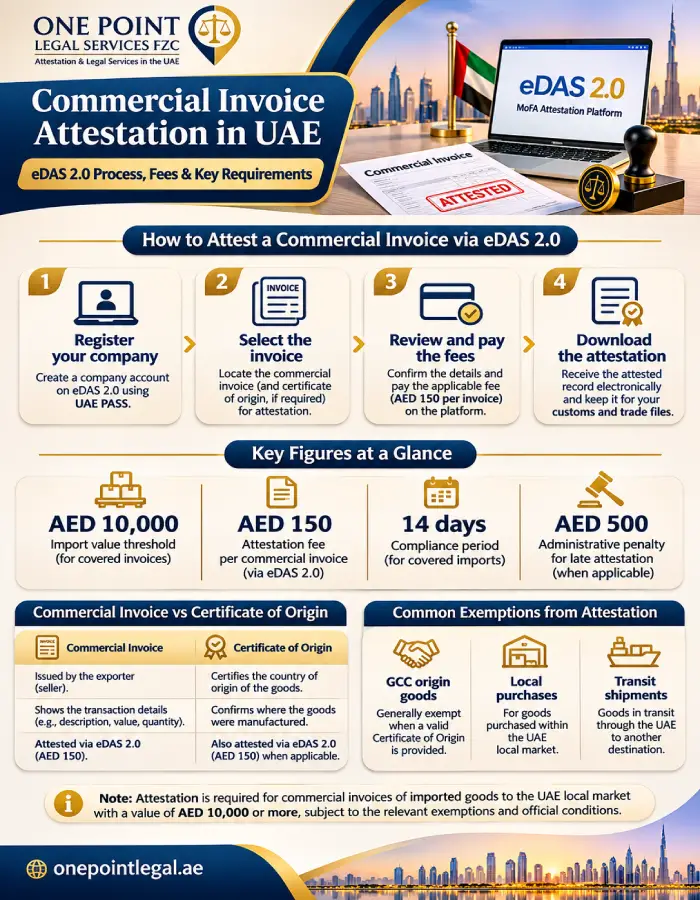
Commercial invoice attestation in UAE is a digital process handled by the UAE Ministry of Foreign Affairs (MoFA) through eDAS 2.0. Under the applicable rules, commercial invoices for goods imported into the UAE local market with a value of AED 10,000 or more generally require attestation, subject to the relevant exemptions. The published MoFA charge is AED 150 per commercial invoice, and a 14-day compliance period applies to covered imports.
The main challenge for importers is not simply paying a fee. It is identifying which invoices are covered, matching the invoice to the correct customs declaration, handling any Certificate of Origin (COO) payment, and avoiding an overdue transaction. The route differs for goods manufactured in the GCC, genuine third-country transit and movements involving UAE free zones.
This guide explains the current eDAS 2.0 procedure, fees, supporting documents, exemptions, deadlines and common problems, using official UAE government sources and the latest Ministry service guidance.
Need to confirm whether your import invoice requires MoFA attestation? One Point Legal Services can help you review the documents, identify missing information and coordinate available attestation support.
Government approvals and digital attestations are issued by MoFA. Service availability depends on the transaction.
What Is Commercial Invoice Attestation in UAE?
Commercial invoice attestation is the official authentication of invoice information through MoFA’s Electronic Documents Attestation System, eDAS 2.0. It supports compliance for covered goods imported into the UAE local market. The digital result includes electronically authenticated information that businesses can retain with their import records.
A commercial invoice normally records the seller, buyer, description of goods, quantities and prices. Attestation does not replace the customs declaration, verify that goods were delivered, determine their customs value or guarantee acceptance of incorrect invoice details. Customs compliance and MoFA attestation remain distinct responsibilities.
On 8 June 2026, MoFA discontinued eDAS 1.0 and moved users exclusively to eDAS 2.0. The newer service allows registered businesses to review transactions, pay attestation charges and obtain digital confirmations. It also supports linked Certificates of Origin and optional physical-document attestation where applicable.
Businesses should use the current MoFA eDAS 2.0 service, not instructions or screenshots for the retired platform. The Ministry’s June 2026 announcement confirms the change.
Is Commercial Invoice Attestation Mandatory in the UAE?
Yes, for covered imports. Cabinet Resolution No. 38 of 2022, as reflected in the official UAE legislation and MoFA’s current eDAS guidance, establishes an attestation requirement for relevant invoices of imported goods valued at AED 10,000 or more. The requirement took effect on 1 February 2023; eDAS 2.0 is the current platform used to administer it.
The important distinction is imported goods entering the UAE local market, not every document called an invoice. An invoice for a service contract, a purely domestic sale or a shipment that only passes through a third country may need different treatment. A value below AED 10,000 is outside the general invoice threshold described in the legislation, but a company should still check whether another documentation requirement applies to the shipment.
Quick decision guide: Does your invoice need eDAS attestation?
| Transaction | Usual position | What to check |
|---|---|---|
| Imported goods entering the UAE mainland/local market; invoice AED 10,000 or above | Generally subject to eDAS attestation | Customs entry, invoice value and any applicable exemption |
| Imported goods; invoice below AED 10,000 | Below the general mandatory invoice threshold | Other authority or transaction-specific requirements |
| Goods manufactured in a GCC state | May qualify for exemption | Evidence of GCC origin and the COO requirements |
| UAE onshore-to-onshore domestic sale | Generally outside the import-invoice requirement | Confirm that no free-zone-to-mainland movement is involved |
| Goods entering a UAE free zone without local-market entry | May be outside the local-market attestation requirement | Customs regime and final destination |
| Goods transferred from a UAE free zone into the mainland | May require attestation | Local-market entry, customs documents and value |
| Genuine transit shipment from one foreign country to another | Generally outside the local-market import requirement | Proof that the goods do not enter the UAE local market |
The table is a screening guide, not an approval of an exemption. MoFA’s attestation FAQs describe the relevant routes, including GCC-manufactured goods, domestic transactions, transit and free-zone movements. For an unusual shipment, seek confirmation from the competent customs authority and MoFA rather than assuming an exemption applies.
How to Attest a Commercial Invoice in UAE Through eDAS 2.0
Commercial invoice attestation in UAE is completed online through eDAS 2.0 after the business account has been approved and the relevant transactions are available. The current service is designed around company registration, UAE PASS access, transaction review, payment and digital attestation.
Step 1: Register the company and activate access
Open the official eDAS registration page through MoFA. Register the company using its valid trade licence and the requested business contact details. MoFA must approve the main company account before its administrator can assign access to authorised users.
Users sign in through UAE PASS. If you work with more than one registered business, select the correct company workspace before reviewing transactions. An employee’s personal UAE PASS login alone does not establish an approved company account.
Step 2: Find the relevant invoice and customs entry
Once inside the selected company workspace, review the available invoice or Certificate of Origin transactions. Match the displayed information to the commercial invoice and the relevant Bill of Entry (BOE) or customs declaration. Check invoice numbers, seller and buyer details, value, origin and the nature of the goods.
The upgraded system can display customs-linked invoice transactions and reduce manual data entry. However, do not assume that every transaction is upload-free: where eDAS asks for the commercial invoice, Certificate of Origin or supporting files, provide them in the format requested. MoFA’s general FAQs include document-upload instructions that may apply to particular workflows. Follow the requirements shown in the current eDAS 2.0 account.
Step 3: Resolve any Certificate of Origin payment dependency
MoFA’s current FAQs state that payment of the Certificate of Origin (COO) component unlocks payment of associated invoice attestation requests. The system can offer separate or combined payment options for the COO and invoices. Follow the amounts and linked records shown for your declaration.
This payment dependency must not be confused with mandatory upload of a physical COO document for stamping. MoFA describes certain document uploads and physical-attestation options as optional, depending on the receiving authority’s compliance requirements. If the transaction is treated as exempt because of GCC origin, check its special COO evidence requirements rather than paying or uploading documents without reviewing the exemption.
Step 4: Review charges and complete payment
Select the transaction or group of transactions eligible for payment. eDAS 2.0 supports bulk payment of invoices and COO items. Check whether an overdue fine has been added, verify the selected company and amounts, then complete payment using the available gateway.
Keep the payment receipt. If the amount has been debited but the system still shows an outstanding transaction, do not immediately pay a second time; contact the company administrator or MoFA support for payment reconciliation.
Step 5: Download the attested record and retain evidence
After successful processing, the platform provides the attestation record and payment receipt. The Ministry’s user guide explains that digital records may incorporate a QR code, electronic seal and digital signature. Retain the completed attestation with the relevant invoice, COO and customs documentation.
Where a receiving party specifically requires a stamped copy of a physical document, MoFA states that users may upload a copy for physical-document attestation without an additional attestation charge for that option, subject to the service’s conditions. Confirm the available option within the current transaction.
For screenshots and navigation details, use the official eDAS 2.0 user manual.
Documents Required for Commercial Invoice Attestation
The two central records in the eDAS service are the commercial invoice and the Certificate of Origin, together with the company’s registration details and the customs transaction to which the invoice relates. Not every transaction requires the same upload action, but the information must be consistent.
Before applying, prepare and check:
- Valid company trade licence: for primary company registration and account approval.
- Authorised user’s UAE PASS access: linked to the correct company workspace.
- Commercial invoice: showing accurate invoice number, buyer, seller, currency, description and value of goods.
- Certificate of Origin information: including evidence required for a GCC-origin exemption or any linked COO transaction.
- Bill of Entry or customs declaration details: to identify the relevant shipment and monitor the attestation deadline.
- Supporting records when requested: such as documents explaining a mismatch, returned request or exemption claim.
An invoice with inconsistent values or an incorrect company association may need correction before an attestation request can be completed. If the invoice has already been authenticated with a valid MoFA stamp, check whether another attestation is needed rather than automatically creating a second application.
Commercial Invoice Attestation Fees in UAE
The published MoFA fee is AED 150 for each commercial invoice under the eDAS 2.0 service. The Ministry also lists AED 150 per Certificate of Origin. These are government attestation charges, not a quotation for the entire shipment, customs clearance or third-party document support.
| Item | Published MoFA charge | Key point |
|---|---|---|
| Commercial invoice via eDAS 2.0 | AED 150 per invoice | For a transaction requiring invoice attestation |
| Certificate of Origin (COO) via eDAS 2.0 | AED 150 per COO | Check the linked payment dependency and applicable exemption |
| Overdue covered invoice | AED 500 administrative fine | In addition to the outstanding attestation charge when applicable |
| Other ordinary commercial documents | AED 2,000 for the published commercial-document category | Different service from eDAS invoice attestation |
| External document preparation or coordination | Varies | Not included in the government fee above |
Fee illustration: If an importer has one covered commercial invoice and one chargeable linked COO, the listed MoFA amounts total AED 300 (AED 150 + AED 150), before any additional service or transaction-specific charges. If the same invoice attracts an applicable AED 500 late fine, the total shown could become AED 800. This is an illustration only; the actual payment screen and the company’s exemption status determine what is payable.
The distinction between AED 150 for an eDAS invoice and AED 2,000 for a different commercial-document attestation category matters. A commercial contract or board resolution is not the same as an import commercial invoice. See MoFA’s eDAS service fees and its general attestation FAQs.
The 14-Day Deadline and AED 500 Late Penalty
For invoices subject to mandatory attestation, the UAE rules provide a 14-day period linked to the goods’ entry into the country. The MoFA eDAS 2.0 user guide instructs companies to track the period using the Bill of Entry (BOE) date, and the current FAQ describes the deadline for payment of the invoice attestation fee.
Under Article 3 of Cabinet Resolution No. 38 of 2022, a failure to meet the attestation obligation may result in an AED 500 administrative penalty, with penalties accumulating as violations accumulate. The eDAS instructions express the penalty as AED 500 per overdue invoice. Late payment does not remove the obligation to pay the underlying attestation charge.
Can a business challenge an AED 500 late-attestation penalty?
Yes. Article 3(2) of Cabinet Resolution No. 38 of 2022 allows an interested party to submit a reasoned written grievance to MoFA within 15 days of being notified of the administrative penalty decision, together with supporting documents. The Resolution provides for a decision on the grievance within 30 days of its submission, under the Ministry’s procedures. These statutory periods concern the grievance against the penalty; they should not be confused with the separate 14-day invoice-attestation compliance period.
Keep the penalty notification, Bill of Entry, invoice, transaction history and any proof of timely payment or an incorrect customs record. Contact MoFA promptly through its official support channels to confirm the applicable submission route. Filing a grievance does not, by itself, establish that the penalty has been cancelled.
Practical example: an invoice that becomes overdue
A company imports goods into the UAE local market under a customs declaration and has a covered invoice worth AED 25,000. The company should identify the BOE date, check the 14-day compliance deadline in eDAS 2.0 and pay the applicable invoice and linked COO charges in time. If the invoice becomes overdue, the system may show the AED 500 late fine in addition to unpaid attestation charges.
Do not calculate the deadline from the supplier’s invoice date or the date the goods were ordered. Also, do not assume that completion of customs clearance automatically removes the separate attestation requirement. Dubai Customs’ August 2025 integration update removed the need to enter an attestation number manually into its declaration system, but it did not repeal the MoFA attestation obligation.
Which Commercial Invoices Are Exempt from Attestation?
Not every invoice is subject to mandatory eDAS attestation. Exemption or out-of-scope treatment depends on the goods’ origin, value, destination, customs status and proof available. The following distinctions are particularly important for importers.
GCC-manufactured goods
MoFA states that goods manufactured in GCC countries are exempt from the relevant invoice-attestation obligation when the exemption conditions are met. Its FAQs specify that the relevant documents must be uploaded into eDAS together with the Certificate of Origin to support the exemption; the COO does not itself need attestation for this exemption. Simply shipping goods from a GCC country does not establish GCC manufacture. Other government services may still require separate document attestation.
Goods that do not enter the UAE local market
A genuine third-country transit movement and goods entering a free zone without entering the UAE mainland may fall outside the local-market attestation route. The shipping documentation and customs regime should support that treatment.
Free-zone-to-mainland transfers are different. MoFA specifically identifies movements from a free zone into the UAE local market as transactions that may need eDAS processing. Importers should not label all free-zone shipments as exempt.
Purely domestic transactions
An invoice reflecting an ordinary onshore-to-onshore sale within the UAE generally falls outside an attestation requirement intended for imported goods. That position should not be applied to a movement from a free zone into the local market.
Already attested invoices
MoFA’s FAQs distinguish documents already carrying a clear valid MoFA stamp from invoices that still need attestation. Check the existing authentication and its applicability before submitting or paying for a duplicate transaction.
Do not rely on broad exemption lists without checking the exact shipment. For goods below AED 10,000, personal imports, special institutional imports or unusual customs arrangements, review the applicable government instructions and obtain clarification where needed. The Ministry’s official FAQs remain the starting point.
Commercial Invoice vs Certificate of Origin
A commercial invoice records a sale and its financial details. A Certificate of Origin (COO) identifies the stated origin of goods and may support customs treatment or an eDAS exemption. Both may appear in one import transaction, but they are not interchangeable.
| Question | Commercial invoice | Certificate of Origin |
|---|---|---|
| Main purpose | Record seller, buyer, goods and transaction value | Document the stated origin of the goods |
| Main use in eDAS 2.0 | Invoice attestation for covered imports | Linked COO processing and origin evidence |
| Published MoFA fee | AED 150 per chargeable invoice | AED 150 per chargeable COO |
| Typical issue to check | Value and invoice-to-customs match | Origin and relationship to the invoice/declaration |
| Does one automatically replace the other? | No | No |
A key operational detail is that the eDAS 2.0 platform can require COO payment before invoice payment becomes available. The document-upload requirements for a stamped COO copy are not necessarily identical to this payment dependency. Follow the current transaction workflow rather than older guides designed for eDAS 1.0.
How Long Does eDAS 2.0 Attestation Take?
MoFA lists a two-minute service-completion time for the eDAS 2.0 attestation service and says the digital service is available 24 hours a day, seven days a week. This published service time should not be presented as a guarantee for every end-to-end application.
Company registration and approval, customs-data availability, a payment mismatch or a returned request may increase the total elapsed time. The MoFA manual indicates that certain service requests and returned approvals can require review over several working days. If a payment is processed but not reflected, use the official support channel rather than repeatedly paying.
The safest approach is to register the company before an urgent import, monitor invoice entries regularly and keep the BOE dates visible to the staff member responsible for compliance.
Common eDAS 2.0 Errors and How to Avoid Them
Most preventable problems arise from incomplete company access, incorrect transaction data or misunderstanding the payment sequence. Review the following before submitting:
- Using an unapproved company account. Complete company registration with the trade licence and obtain approval before assigning users.
- Selecting the wrong company workspace. Check the legal entity associated with the import and the invoice.
- Missing the BOE deadline. Record the customs entry date and monitor outstanding transactions, not only paper invoices.
- Confusing COO payment with physical document upload. Check the system’s payment dependency and any separate stamping requirement.
- Treating all GCC or free-zone shipments as exempt. Verify the origin and whether goods entered the mainland market.
- Entering inconsistent invoice details. Match the invoice, customs declaration and origin records before payment.
- Paying twice after a technical issue. Save the payment confirmation and ask the company administrator or MoFA to reconcile the transaction.
- Using an outdated eDAS 1.0 tutorial. The former version was discontinued in June 2026; follow eDAS 2.0 instructions.
If an attestation or service request is returned, review the reason, submit the requested evidence and use the platform’s resubmission function where available. MoFA’s eDAS manual explains how returned requests are handled.
How One Point Legal Services Can Assist
One Point Legal Services can help businesses review commercial invoices and associated documentation, understand the relevant attestation route, identify incomplete records and coordinate available document-support steps. For companies managing several types of paperwork, this can also include clarifying whether an item belongs in eDAS 2.0 or in another official attestation category.
Our role is document and procedural support, not the issuance of governmental attestations, customs decisions, exemptions or administrative penalty waivers. These decisions remain with MoFA and the competent customs or government authorities.
For broader assistance, see our attestation services in Dubai and UAE legal services for businesses. If your document requires consular legalization rather than eDAS processing, read about embassy attestation. You can also contact One Point Legal Services for a document-specific review.
Managing an import invoice, COO payment or eDAS 2.0 issue? Send us the document type, customs-entry details and the issue you need reviewed so we can explain the available support.
MoFA remains the official attestation authority. Fees and outcomes depend on the specific transaction.
Frequently Asked Questions
How do I attest a commercial invoice in the UAE?
Register your company for eDAS 2.0 using its trade licence, obtain account approval and sign in with UAE PASS. Select the correct company, review the invoice or customs-linked transaction, complete any applicable Certificate of Origin payment and pay the invoice attestation charge. Download the completed digital record and receipt. If the invoice is missing from the system, check the customs-entry details and contact MoFA support.
How much does commercial invoice attestation cost in the UAE?
The UAE Ministry of Foreign Affairs publishes a fee of AED 150 per commercial invoice through eDAS 2.0 and AED 150 per chargeable Certificate of Origin. A linked COO payment may be required before the invoice payment becomes available. An applicable late fine of AED 500 can increase the amount due. Other commercial documents, such as agreements or corporate resolutions, may fall under a separate fee category.
Is invoice attestation required for imports below AED 10,000?
The general mandatory invoice-attestation threshold under Cabinet Resolution No. 38 of 2022 is AED 10,000 or more for relevant imported goods. An invoice below that threshold is generally outside this specific obligation, but the importer should still check whether customs, sector-specific or receiving-authority requirements apply. The threshold should not be used to assume that every document linked to the shipment is exempt from other formalities.
What happens if I do not attest an invoice within 14 days?
For a covered import, MoFA's eDAS guidance provides a 14-day period from the Bill of Entry date to meet the invoice attestation payment requirement. Missing that deadline can trigger an AED 500 fine per overdue invoice, in addition to the outstanding attestation fee. Penalties can accumulate across transactions. Check the status and actual amounts in the company's eDAS account rather than calculating charges from the supplier's invoice date.
Is a Certificate of Origin mandatory in eDAS 2.0?
The current platform links Certificate of Origin (COO) payments to associated invoice attestation requests; MoFA states that completing COO payment makes invoice payment available. That does not mean a stamped physical COO must always be uploaded. Upload requirements depend on the particular workflow and the receiving authority. For GCC-manufactured goods, origin evidence is particularly important when requesting exemption from invoice attestation.
Are commercial invoices from GCC countries exempt?
GCC-manufactured goods are exempt from the relevant invoice-attestation requirement when MoFA's stated conditions are met. The Ministry instructs users to upload the documents with the Certificate of Origin to demonstrate the exemption, but says the COO does not need to be attested for that purpose. Goods shipped from a GCC country are not automatically manufactured there. Check the true origin and the transaction, and remember that a separate document attestation may be required for another government service.
Do invoices for goods entering a UAE free zone require attestation?
Goods entering a free zone without entering the UAE local market may fall outside the general eDAS import-invoice requirement. However, transfers from a free zone to the UAE mainland are not automatically exempt and may need attestation depending on the customs declaration and invoice value. Check the destination and customs procedure, not only the address of the importing company. MoFA lists free-zone-to-mainland movements among transactions that can require eDAS processing.
Can I obtain commercial invoice attestation online without visiting MoFA?
Yes. MoFA operates eDAS 2.0 as an online service for registered businesses. Users access approved company accounts through UAE PASS, review and pay eligible transactions, and obtain digital attestation records. A separate request may be available if a receiving authority also needs a physical copy stamped. Registration approval, returned requests or payment reconciliation can take longer than the two-minute service time shown on MoFA's service page.
Conclusion
Commercial invoice attestation in UAE now runs through MoFA’s eDAS 2.0 platform. For relevant imports worth AED 10,000 or more, companies should confirm whether the invoice is covered, track the 14-day period from the customs entry, review any linked COO payment and retain the resulting digital attestation. The published invoice charge is AED 150, while exemptions and late fines depend on the actual transaction.
Accurate origin records, consistent invoice details and regular monitoring of eDAS transactions can prevent avoidable errors. One Point Legal Services can help review documentation and clarify available attestation support, while official approvals remain with the competent authorities.
Official UAE Sources and References
- UAE Ministry of Foreign Affairs – Commercial Invoice Attestation via eDAS 2.0 – current service steps, fees and published processing time.
- UAE Ministry of Foreign Affairs – eDAS 2.0 transition notice, 8 June 2026 – retirement of eDAS 1.0.
- UAE Legislation – Cabinet Resolution No. 38 of 2022 – legal framework for relevant attestation fees and penalties.
- MoFA – eDAS 2.0 User Manual – registration, transactions, payment and supporting records.
- MoFA – Official FAQs – certificate-of-origin payments, exemptions and transaction issues.
- Dubai Trade – Dubai Customs eDAS 2.0 Process Update – Dubai customs integration update.
Information notice: This article provides general procedural and regulatory information as checked. It is not a customs ruling, a guarantee of exemption or individual legal advice. Confirm the exact transaction status, applicable charges and latest requirements with MoFA and the competent customs authority before taking action.
