

A private notary in Dubai is an individual registered with Dubai Courts to perform specific notarial functions within the authority granted under Dubai law. These services may include attesting signatures on powers of attorney, certain contracts, declarations, and other legal instruments. A private notary cannot automatically perform every function assigned to a government notary.
Before arranging notarisation, you should confirm that the private notary and the relevant firm are authorised, that the document falls within the notary’s permitted functions, and that you understand the required documents, fees, signing process, and delivery method.
This guide explains the difference between a private and a government notary, how to verify a private notary’s authorisation in Dubai, the scope of available services, required documents, online and in-person procedures, and the fees applicable in Dubai. It also explains when the rules of other UAE authorities may differ.
What Is a Private Notary in Dubai?
A private notary in Dubai is a natural person registered on the official roll to undertake certain functions of a government notary under the legislation governing notarial services in the emirate.
Article 2 of Dubai Law No. 4 of 2013, as amended by Law No. 26 of 2021, defines a Private Notary Public as a natural person registered on the roll to exercise particular government notary functions.
There is an important distinction between the individual private notary and the firm through which the service is provided. The notary must be properly registered, while the firm must hold the relevant authorisation from Dubai Courts to provide notary public services.
At the federal level, Federal Decree-Law No. 20 of 2022 on the Regulation of the Notary Public Profession, together with Cabinet Resolution No. 16 of 2024, regulates notarial work within its applicable scope. However, Article 2 of the federal decree-law excludes local judicial authorities whose notarial functions are regulated by their own local legislation.
Consequently, procedures in Dubai, Abu Dhabi, and jurisdictions operating under the federal system may differ. A private notary service is nevertheless an official legal process when it is performed by an authorised professional within the scope of the relevant legislation.
Private Notary vs Government Notary in Dubai: What Is the Difference?
The main differences between a private notary and a government notary relate to professional status, the scope of authorised functions, how the service is delivered, and applicable charges. The distinction does not mean that a lawfully notarised instrument has less evidentiary value solely because a private notary handled it.
A government notary performs functions through the relevant official authority, while a private notary performs only those functions assigned or permitted under the applicable rules and authorisation.
| Point of comparison | Government Notary | Private Notary |
|---|---|---|
| Legal status | A public servant or other person performing notarial duties under the relevant official system. | An individual registered or licensed to exercise specified functions. |
| Where services are provided | Relevant courts or government notary channels. | A firm or office authorised under the applicable system. |
| Scope of functions | Functions prescribed by law. | Functions assigned under the law and relevant authorisations. |
| Online notarisation | Available for eligible transactions under approved procedures. | May be available when the function and channel are authorised. |
| Supervision | Subject to the relevant official oversight. | Subject to registration, authorisation and regulatory supervision. |
| Charges | Applicable government fees. | Applicable government fees and private notary remuneration, depending on the transaction. |
Does a Private Notary’s Document Have the Same Legal Effect?
A document does not have reduced evidentiary value merely because an authorised private notary processes it, provided the notary acts within the permitted functions and all legal requirements are met.
In Dubai, Article 35 of the Notaries Public Law, as amended, provides for the evidentiary value of official documents in relation to traditional and electronic instruments processed by a notary public.
However, lawful notarisation does not necessarily make a document acceptable for every purpose. The receiving authority may still require registration, additional attestation, a particular document format, or other steps.
Is a Private Notary Faster Than a Government Notary?
A private notary may offer appointment options or service channels that are convenient for certain transactions, but a faster turnaround is not guaranteed. Processing time depends on the document type, completeness of the paperwork, number of parties, identity verification, signing requirements, and availability of online services.
The correct starting point is to confirm the notary’s authority and the receiving organisation’s requirements rather than selecting a provider solely on the basis of an advertised completion time.
How to Verify a Licensed Private Notary in Dubai
To verify a private notary in Dubai, consult the official register or list published by Dubai Courts, match the firm and notary details, and confirm that the requested service is within the notary’s authorised functions.
Dubai Courts provides an official Private Notary Offices directory that can be used to review details of listed firms and registered notaries.
Before submitting an application or making payment, check the following:
- Firm name: Confirm that the office is listed or otherwise verify its current authorisation with Dubai Courts.
- Registered notary: Match the individual handling the transaction against the relevant registration details.
- Validity: Confirm that the registration and firm authorisation remain valid at the time of the transaction.
- Permitted service: Check that the required document and notarial procedure fall within the notary’s approved functions.
- Delivery method: Confirm whether the transaction can be completed remotely or requires attendance.
Under Article 14 of Dubai’s Notaries Public Law, as amended, an authorised firm must display its authorisation prominently so that members of the public can inspect it. If the firm’s status or permitted services are unclear, contact Dubai Courts directly before proceeding.
How Does Verification Work in Abu Dhabi?
The Abu Dhabi Judicial Department provides information about private and government notary services and the offices involved. Its official channels can help you confirm the appropriate provider and transaction requirements in Abu Dhabi.
Authorisation in one emirate should not be treated as automatic permission to perform every service available in another emirate. Always check the rules of the authority responsible for your document.
What About UAE Federal Notary Services?
For transactions within the federal system, consult the UAE Ministry of Justice and its relevant notary services. Federal implementing regulations address the registration and practice of private notaries within their scope of application.
A trade licence held by a legal services business is not, by itself, proof of authority to notarise documents. Formal notarial authority must be established separately.
What Services Can a Private Notary in Dubai Provide?
A private notary in Dubai may perform only the notarial functions that the competent authority has assigned or permitted. These functions must not be assumed to include every duty available to a government notary.
Article 20 of Dubai’s Notaries Public Law, as amended, sets out the functions of notaries public and provides for the Director of Dubai Courts to assign specified government notary functions to private notaries.
Depending on the relevant authorisation, the services may include:
- Attestation of general and special powers of attorney: Where the authorisation covers the relevant document and legal requirements are satisfied.
- Signature attestation: For qualifying contracts, agreements and other instruments.
- Instrument date validation: In accordance with the applicable procedures and official records.
- Attestation of certain declarations and instruments: Subject to document type and authorised scope.
- Legal warnings and notices: Where the particular service is authorised.
- Wills made by non-Muslims: Subject to the legal requirements and permitted functions.
- Affixing an executory formula to certain instruments: Where legal conditions are satisfied and the function is assigned to the notary concerned.
The inclusion of a service in the general notarial legislation does not establish that every private notary office is authorised to provide it. Check the particular transaction and authorisation before applying.
Which Transactions Cannot Be Notarised Under Dubai’s Notary Rules?
Article 21 of Dubai’s Notaries Public Law places restrictions on transactions that a notary may register or attest. Important restrictions include:
- Muslim family affairs and endowments (waqf): To the extent restricted under the legislation.
- Certain real property rights: Transactions creating, transferring, changing, or extinguishing ownership or other real rights in property.
- Matters reserved for another authority: Where legislation gives another body exclusive registration or attestation powers.
- Unlawful instruments: Documents that breach applicable legislation, public order or public morals.
- Conflicts of interest: Transactions affected by the statutory restrictions relating to the notary and specified relatives or associated persons.
These points concern the applicable Dubai legislation. They should not be presented as a single nationwide list without reviewing the rules in the relevant emirate.
Practical Examples: Choosing the Correct Notarisation Route
A person seeking to issue a special power of attorney may be able to use an authorised private notary if the document is within the notary’s permitted functions and complies with the relevant requirements.
By contrast, transferring real estate ownership involves the competent land registration authority. Signature attestation alone is not a substitute for property registration.
For a document concerning family affairs, the relevant court or competent notarial authority should be identified according to the nature of the transaction. In each case, the intended legal effect of the document should be established before selecting a notary office.
Private notary services in Dubai depend on the type of document and the notary’s authorised scope. One Point Legal Services can help you review your document, identify the appropriate notarisation process, and understand the required documents and procedures before applying.
Check Your Notarisation Requirements
Contact us on WhatsApp with your document type and notarisation requirements.
Documents Required and Steps for Private Notary Services in Dubai
Required paperwork depends on the instrument, the parties’ legal status, the proposed procedure and the competent authority. There is no single mandatory checklist covering every private notary transaction in Dubai.
Documents Commonly Required from Individuals
Depending on the application, supporting documents may include:
- Emirates ID or passport, as applicable.
- Identification and contact details of the parties.
- A draft power of attorney, agreement, declaration or other instrument.
- Documents proving the party’s legal capacity or rights in the transaction, when necessary.
- An existing power of attorney or other authority document if someone acts for another person.
- Any additional documents required by the notarial authority to verify the transaction.
Check that names and other details match the supporting identification documents before submission, especially where a draft has been prepared in a different language.
Documents Commonly Required from Companies
Corporate notarisation may require:
- A valid trade licence.
- The memorandum of association, articles of association or other relevant constitutional documents.
- Details of the authorised signatories.
- A partners’ or board resolution when needed to establish authority.
- The draft document requiring notarisation.
- Additional evidence of the representative’s power to carry out the intended act.
Being a shareholder does not automatically entitle someone to execute every document on a company’s behalf. The company’s governing documents and the signatory’s authorised powers must be reviewed.
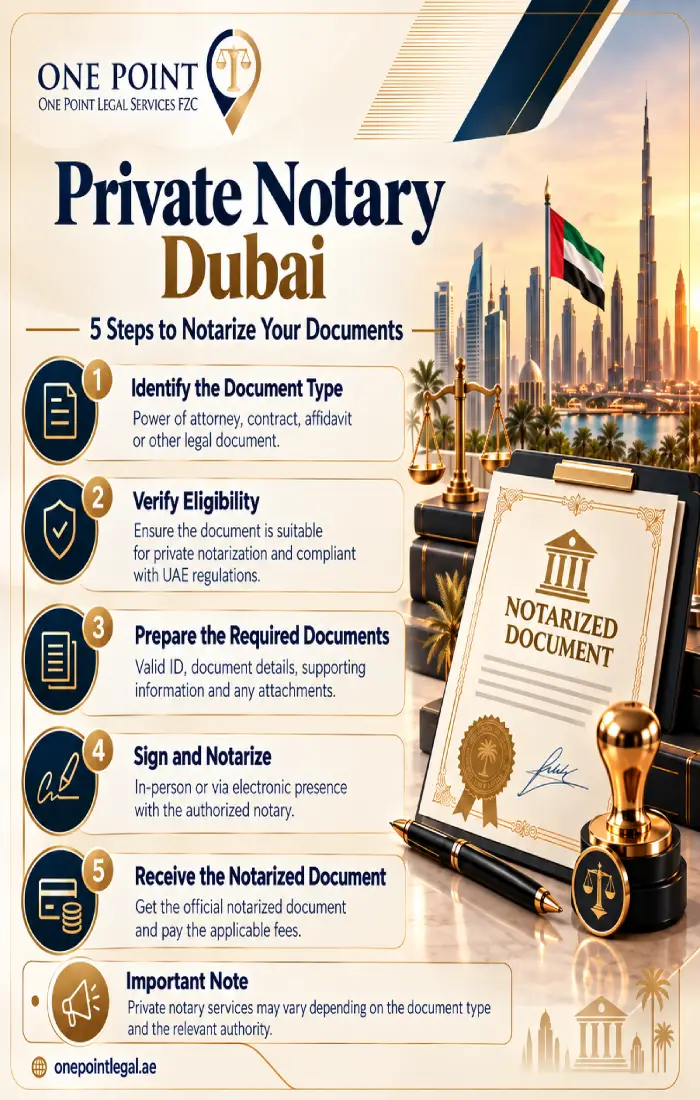
How to Notarise a Document Through a Private Notary in Dubai
The usual procedure can be summarised as follows:
- Identify the transaction: Determine whether you need a power of attorney, signature attestation, date validation or another service.
- Check authority: Confirm that the chosen private notary is authorised to handle the transaction.
- Prepare documents: Collect the parties’ identification, draft instrument and any required supporting paperwork.
- Review the wording: Check names, powers, obligations and the intended legal effect of the document.
- Submit the request: Use the authorised firm or approved electronic service channel.
- Complete verification and signing: Follow the applicable in-person or digital identification and signature requirements.
- Pay applicable fees: Review the government charges, private notary remuneration and any additional costs.
- Receive the notarised instrument: Check its details and the applicable method for verifying authenticity.
You should also check whether the organisation receiving the instrument requires any subsequent registration, legalisation or attestation.
Can Private Notary Documents Be Notarised Online in Dubai?
Yes. Dubai law permits digital notarial processes for eligible transactions in accordance with the applicable rules. Article 35 of the amended Notaries Public Law addresses digital procedures, including identity verification, remote communication, electronic signatures and payment of fees.
Within its own jurisdiction, the UAE Ministry of Justice also offers electronic services for preparing and authenticating contracts and instruments. However, you should not assume that every type of document can be notarised remotely without additional verification or personal attendance.
The service channel, required checks and method of receiving the instrument should be confirmed for the particular transaction.
Private Notary Dubai Fees: Government Charges and Notary Remuneration
Private notary fees in Dubai depend on the transaction type, government charges, the remuneration payable for authorised private notary services, the number of signatures or parties, and any additional services.
Dubai Executive Council Resolution No. 72 of 2025 establishes amended government fee schedules, while Dubai Courts Director’s Resolution No. 312 of 2025 specifies remuneration for the private notary functions listed in its schedule.
The two categories of charges should not be confused: private notary remuneration does not necessarily represent the full cost of the transaction.
Private Notary Remuneration in Dubai
Under Resolution No. 312 of 2025, the following remuneration applies to the scheduled services:
| Service | Private notary remuneration |
|---|---|
| Attestation of a general or special power of attorney | AED 100 per signature |
| Attestation of signatures on an instrument | AED 100 per signature |
| Validation of an instrument’s date | AED 100 per signature |
| Attestation of a translator’s signature on an instrument | AED 100 per signature |
| Attestation of a legal warning or notice | AED 100 per signature |
| Attestation of wills made by non-Muslims | AED 100 per signature |
| Affixing an executory formula to an instrument | AED 100 per signature |
| Electronic registration of party details for services in items 1–7 of the resolution’s schedule | AED 100 per party |
| Request for a certified true paper copy of an instrument | AED 30 |
| Attendance by a private notary outside the regular workplace to provide notarial services | AED 1,000 |
These amounts are the private notary’s remuneration under Resolution No. 312 of 2025. They are not the complete government fee schedule or a universal final quote for every Dubai notarial transaction.
For example, the amended government schedule under Executive Council Resolution No. 72 of 2025 also provides an attestation fee of AED 100 per signature for a general or special power of attorney. Other government fees and service-specific requirements may apply depending on the instrument.
Notarial transactions governed by federal rules or the local systems of other emirates may have different charges. Before applying, ask for a breakdown showing government fees, private notary remuneration and any translation, travel, copying or other additional costs.
When Should You Use a Private Notary in Dubai?
A private notary in Dubai may be suitable where the document falls within the notary’s authorised functions, the firm is properly authorised and the process meets the parties’ and receiving authority’s requirements.
If a transaction requires registration by a specialised authority or a particular judicial procedure, a different route may be necessary.
| Transaction | Appropriate authority or route to check |
|---|---|
| General or special power of attorney | An authorised notary competent to attest that type of power of attorney. |
| Attestation of a signature on a contract or agreement | The notarial authority competent for the particular instrument. |
| Transfer of property ownership | The competent land or property registration authority. |
| Muslim personal status matters | The competent court or authority, depending on the transaction. |
| A document prepared in a foreign language | The appropriate notarial authority, with any required legal translation. |
| A UAE document intended for use abroad | Notarisation followed by any required local, Ministry of Foreign Affairs or consular attestation. |
If your document is in a foreign language, you may need legal translation or another approved language service, depending on the receiving authority’s requirements.
For documents intended for use outside the UAE, additional document attestation or legalisation may be required, including UAE Ministry of Foreign Affairs or consular procedures. Notarisation and Ministry of Foreign Affairs attestation are different steps with different legal purposes.
How One Point Legal Services Can Assist
Preparing an instrument may require reviewing the type of transaction, confirming the powers of the parties and identifying the competent notarial authority—particularly for powers of attorney, company agreements and documents intended for use outside the UAE.
Through its notary public and related legal services, One Point Legal Services helps individuals and businesses understand transaction requirements and coordinate preparation and notarisation procedures within the scope of its services.
Assistance may include:
- Reviewing the document type and intended purpose.
- Identifying the appropriate notarial authority or procedural route.
- Checking party details and the required supporting documents.
- Assisting with preparation or review of the instrument’s wording, as applicable.
- Explaining application, identity verification and signing requirements.
- Coordinating translation or further attestation when necessary.
Formal notarisation remains the responsibility of an authorised notary or other legally competent authority. Document preparation and service coordination by One Point Legal Services do not, in themselves, constitute the exercise of private notary powers.
If your document needs notarisation, contact One Point Legal Services with the document type, emirate and receiving authority so the appropriate requirements and next steps can be identified before you proceed.
Frequently Asked Questions About Private Notary Dubai Services
Is a private notary in Dubai officially authorised?
Yes. Private notaries in Dubai operate under a legal framework requiring registration and appropriate authorisation. However, an advertisement or office name is not sufficient evidence of authorisation. Verify the registered notary, the firm's current status and the notary's authority to handle your specific document. The official Dubai Courts Private Notary Offices directory is a useful starting point for checking registered firms and notaries.
What is the difference between a private notary and a government notary in Dubai?
A government notary performs functions within the official notarial system. A private notary is registered to undertake particular notarial functions under the applicable law and authorisation. Both are subject to the rules governing their respective duties. A document does not lose its legal evidentiary value merely because an authorised private notary processed it, provided the notary was competent and all legal requirements were met.
How can I check whether a Dubai private notary office is authorised?
Consult the official Private Notary Offices directory published by Dubai Courts, compare the firm name and registered notary details, and check the current authorisation and permitted service. If the online information does not clearly establish whether the office can process your particular document, contact Dubai Courts directly before submitting personal documents or paying any fees.
Can a private notary in Dubai notarise a power of attorney?
A private notary in Dubai may attest a general or special power of attorney if the relevant service falls within the notary's authorised functions and the document satisfies the applicable legal requirements. The exact process depends on the type of authority being granted, the identity and capacity of the parties, and the supporting documents. Review the wording carefully before signing.
Can I use an online private notary in Dubai?
Digital notarial procedures are available for eligible transactions under Dubai's applicable rules. Depending on the service, the process may include online application, identity checks, remote communication and electronic signature. However, not every instrument can necessarily be handled online without further checks or attendance. Confirm that the chosen provider and transaction are authorised for the proposed digital process.
How much does a private notary cost in Dubai?
Dubai Courts Director's Resolution No. 312 of 2025 provides private notary remuneration for specified services, including AED 100 per signature for attestation of a general or special power of attorney. It also provides AED 100 per party for electronically recording party details for the services in items 1–7 of its schedule. These amounts do not necessarily represent the final cost because applicable government and other charges may also be payable.
Can a private notary in Dubai notarise real estate transactions?
You must distinguish between notarising a power of attorney relating to a property matter and completing a transaction that creates or transfers property ownership or another real right. Dubai's Notaries Public Law restricts notarisation of specified real property rights transactions. Registration and transfer of property rights remain subject to the competent property authority and the requirements governing the particular transaction.
Can a Dubai-notarised document be used outside the UAE?
Potentially, yes, but acceptance depends on the destination country and receiving authority. Additional UAE Ministry of Foreign Affairs attestation, embassy or consular legalisation, and legal translation may be required. A document's notarisation in Dubai does not automatically mean that it will be accepted by all foreign authorities without further formalities.
Conclusion
A private notary in Dubai provides an authorised route for specific notarisation and signature attestation transactions. The essential checks are the notary’s registration, the firm’s authorisation and whether the intended instrument falls within the permitted functions.
Before selecting a provider, review the supporting documents, the signatory’s powers, the applicable fees and remuneration, the method of signing and the requirements of the receiving authority.
One Point Legal Services can assist with understanding the relevant requirements, preparing documents and coordinating the appropriate steps, while formal notarisation remains the responsibility of the legally authorised authority or notary.
Official Legal Sources and References
- Dubai Law No. 4 of 2013 Concerning Notaries Public in the Emirate of Dubai, including restrictions in Article 21, subject to subsequent amendments.
- Dubai Law No. 26 of 2021 Amending Law No. 4 of 2013, particularly Articles 2, 14, 20 and 35 as amended.
- Dubai Courts – Private Notary Offices, official directory of relevant registered offices and practitioners.
- Dubai Executive Council Resolution No. 72 of 2025, amended government fee schedules for notarial services.
- Dubai Courts Director’s Resolution No. 312 of 2025, remuneration payable for specified private notary services.
- UAE Federal Decree-Law No. 20 of 2022 on Regulation of the Notary Public Profession, particularly the scope-of-application provisions.
- UAE Cabinet Resolution No. 16 of 2024, implementing regulations governing the federal notary system.
- Abu Dhabi Judicial Department – Private and Government Notary Services, relevant Abu Dhabi information for comparison.
Legal disclaimer: This article provides general legal information and does not constitute legal advice for an individual matter. Private notary transactions are subject to the laws, authorisations, procedures and fees of the competent authority and the particular type of instrument. Where interpretation differs, the authoritative Arabic text of the legislation prevails.
