

A bounced cheque UAE does not automatically lead to a criminal case. If a bank refuses payment because there are no funds or the balance is insufficient, Article 667 of Federal Decree-Law No. 50 of 2022 may allow the holder to apply directly to the competent execution court. This route depends on the cheque bearing the bank’s required confirmation of non-payment. Certain deliberate acts, including unlawful stop-payment instructions or intentionally making a cheque unpayable, may still constitute criminal offences.
The first step is to establish why the bank refused payment, whether a partial payment was made, and how much remains due. These details determine what to do next. The guide explains the current UAE law, penalties for specific cheque offences, payment recovery, time limits and practical options for both cheque holders and issuers.
A cheque has been returned unpaid, or you have received a payment demand? One Point Legal Services can review the cheque, bank return memo and payment records to help clarify the available next steps.
Request a Cheque Document Review
Procedural support and coordination; court representation, where required, is handled by duly licensed lawyers.
What Happens When a Cheque Bounces in the UAE?
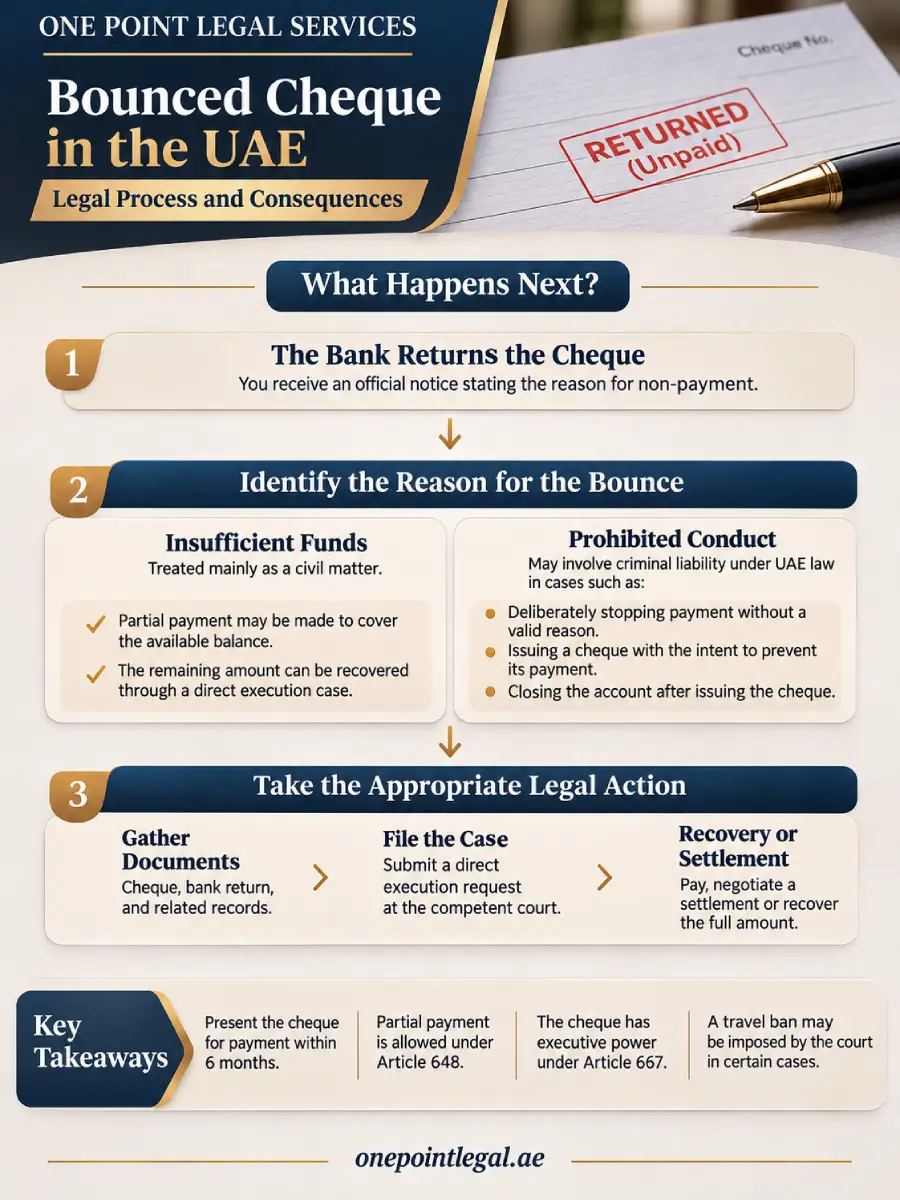
When a bank returns a cheque unpaid, the holder should obtain the return advice identifying the reason. For legal action, ask whether the bank must also date and record its refusal on the cheque itself. Articles 663 and 667 attach importance to the bank’s formal statement; a separate return memo should not automatically be assumed to satisfy every court’s filing requirements. Reasons such as insufficient funds, a closed account or a signature discrepancy can lead to different procedures.
For a cheque returned because of no or insufficient funds, Article 667 may permit direct execution without first obtaining a separate judgment establishing the debt, provided the cheque carries the required bank statement and the filing requirements are met. This does not guarantee recovery. The court follows the applicable execution procedures, and collection depends on the debtor’s position, available assets and any valid legal objections.
A different response may be appropriate where the cheque was allegedly forged, the signature was deliberately manipulated, or the drawer intentionally obstructed payment. Article 663 governs proof of dishonour, while Article 667 establishes the execution mechanism for cheques returned because of a missing or insufficient balance. See the official Commercial Transactions Law.
Bounced Cheque Law in the UAE: What Applies in 2026?
The principal federal legislation governing cheques is Federal Decree-Law No. 50 of 2022 Promulgating the Commercial Transactions Law, in force since 2 January 2023. Under its cheque provisions, an ordinary return caused solely by insufficient funds is not automatically a criminal offence. The law instead provides an execution route for qualifying cheques and retains criminal penalties for defined prohibited conduct.
The current distinction is between payment recovery and specific criminal conduct. A qualifying insufficient-funds cheque bearing the required bank statement may be enforceable through the courts; conduct expressly prohibited by the cheque provisions may still expose the responsible person to a criminal investigation and penalties.
| Issue | General legal position | Main provision |
|---|---|---|
| Cheque returned for no or insufficient funds | Direct execution may be available without a separate merits judgment | Article 667 |
| Only part of the cheque amount is available | Bank must pay the available amount unless the holder refuses; the unpaid balance can remain claimable | Article 648 |
| Bank refuses to pay | The bank’s dated refusal notation on the cheque is legally important; confirm court filing requirements | Article 663 |
| Deliberate obstruction, account closure or an intentionally unpayable signature | Criminal liability may arise if the statutory elements are proved | Article 675 |
| Forgery or knowingly using a forged cheque | Separate criminal offence with its own penalties | Article 676 |
These distinctions are set out in the official Commercial Transactions Law. The Government of Dubai Legal Affairs Department also explains the enforcement route. Whether a particular case is suitable for execution, an ordinary claim or criminal review requires its own assessment.
Why Does a Cheque Bounce? Common Reasons and Their Consequences
A cheque can be returned for different reasons. The bank return reason should be checked before choosing the next procedure, but it is not always conclusive evidence of criminal intention.
| Return reason or circumstance | What it may mean | Appropriate first response |
|---|---|---|
| Insufficient funds | The balance cannot cover the full cheque | Obtain the bank statement, check whether partial payment was made and assess execution under Article 667 |
| No available funds | The account has no drawable balance | Preserve the original cheque and bank proof; assess direct execution |
| Account closed or frozen | The bank cannot honour the cheque through that account | Establish the timing and cause; review whether Article 675 is relevant |
| Stop-payment instruction | Payment was blocked at the drawer’s request | Check the legal basis for the instruction; unauthorised obstruction can carry criminal risk |
| Signature mismatch or irregular completion | The bank could not validate or process the cheque | Determine whether it was an error, a bank issue, or deliberate conduct |
| Suspected forged cheque | Authenticity or authority is disputed | Secure evidence and seek a case-specific legal review before filing |
A clerical error should not be described as fraud without evidence. Likewise, a bank’s “signature differs” notation alone does not prove the intention required under Article 675. The bank’s explanation is a starting point, not a final legal finding.
Is a Bounced Cheque a Criminal Offence in the UAE?
Insufficient funds alone are not automatically a criminal offence under the current UAE cheque regime. Criminal liability is reserved for particular conduct defined by the law. The facts, intent and supporting evidence matter.
Acts that may attract criminal liability
Article 675 addresses conduct including ordering the bank not to cash the cheque outside the legally permitted cases; closing the account, withdrawing its entire balance or knowingly issuing against a closed account; intentionally causing the account to be frozen; and deliberately writing or signing a cheque to prevent payment.
Article 674 deals with knowingly endorsing or transferring an unpaid bearer cheque in the circumstances defined by that provision. Article 676 addresses forgery and related offences, including knowingly using a forged cheque. A bank employee’s intentional misconduct concerning dishonour or partial payment is separately addressed by Article 673; it should not be confused with the drawer’s ordinary insufficient-balance return.
What are the penalties for cheque offences?
The possible punishment depends on the offence proved, not simply on the fact that a cheque was returned:
- Article 674: A fine of at least 10% of the cheque’s value, with a minimum of AED 1,000 and a statutory ceiling of twice its value, for the conduct specified in the article.
- Article 675: Imprisonment of six months to two years, a fine, or both. The fine is at least 10% of the cheque’s value, with a minimum of AED 5,000, and may not exceed twice the cheque’s value. The article provides for doubled penalties on reoffending.
- Article 676: Imprisonment of at least one year and a fine of AED 20,000–100,000 for the forgery-related offences it defines.
These are legal ranges, not automatic penalties for insufficient funds. The relevant wording appears in Articles 674–676 of the official law.
What Should You Do If You Receive a Bounced Cheque?
If you are the beneficiary, start by preserving the evidence and establishing the unpaid balance. The following order helps avoid filing on the wrong factual basis.
- Present the cheque through the bank on or after its stated date and request the return advice and any required notation on the original cheque.
- Check the precise reason for dishonour. Confirm whether the problem was insufficient funds or another circumstance requiring investigation.
- Check for partial payment. If the bank paid part of the amount, obtain the certificate and the original cheque bearing the appropriate endorsement.
- Gather the transaction records. Keep contracts, invoices, receipts, messages and evidence of earlier transfers or settlements.
- Consider an evidenced payment request or negotiated settlement. Record any arrangement in writing rather than relying on an oral promise.
- Assess the correct legal route. An insufficient-funds cheque may qualify for direct execution; suspected prohibited conduct may require separate legal assessment.
Under Article 667, the qualifying cheque bearing the bank’s confirmation is an executive instrument; the applicant must still follow the court’s filing and notification requirements. The Dubai Government Legal Affairs Department explains the significance of the bank’s statement.
For the court-filing stages, documents and execution objections specifically in Dubai, see One Point Legal’s detailed guide to cheque execution in Dubai. The execution procedure differs from this article’s broader explanation of the legal consequences of a bounced cheque.
What If You Issued a Cheque That Bounced?
A cheque issuer should not assume that the absence of an automatic criminal offence means the debt can be ignored. Civil execution may still expose eligible assets to court-ordered enforcement, and an issuer may need to respond promptly to notices or proceedings.
First, check the bank’s stated return reason and compare the amount demanded with your records. Collect proof of payments, transfers, replacement cheques, agreed settlements and any dispute about the original transaction. If a sum is genuinely outstanding, a documented and realistic payment proposal may help resolve the matter. Avoid signing an acknowledgment of amounts you cannot verify.
If the cheque has already been presented for execution, informal assurances are not a substitute for addressing the actual court file. The issuer may need to submit payment evidence, a legally grounded objection or a request concerning instalments through the competent procedures. An objection does not automatically suspend enforcement.
Where there is evidence of forgery, misuse, duplicate recovery or an amount already discharged, preserve the original records and seek a qualified legal assessment. Do not alter a cheque, conceal records or issue unsupported stop-payment instructions.
Can a Bank Make a Partial Payment on a Bounced Cheque?
Yes. Article 648 requires the drawee bank, when the available funds are below the cheque value, to pay the available amount unless the cheque holder refuses that partial payment. The bank must record each partial payment on the cheque and hand the holder the original cheque and a certificate confirming the amount paid. The holder may still seek the unpaid balance through the applicable procedure.
For example, suppose a cheque is for AED 60,000, but the bank can pay only AED 18,000. If the holder accepts that amount, the remaining principal is AED 42,000. The payment certificate becomes important evidence so that the amount already received is not claimed again. This is an illustrative calculation, not a prediction of legal costs or recovery.
Accepting a partial payment does not automatically waive the outstanding amount. Article 648 expressly provides for claiming the balance using the endorsed original cheque under Article 667 or the statutory protest route, where applicable. See the official text of Article 648.
How Long Do You Have to Present or Claim a Bounced Cheque?
Presentation and legal recourse are different time questions. Article 649 generally provides a six-month presentation period for a cheque payable in the UAE, running from its stated date of issue. Missing that period does not necessarily mean the underlying obligation disappears, but it can affect legal rights and the route available.
Article 670(1) states that, where the claim is denied and no lawful excuse exists, certain recourse claims against the drawer, endorsers and other parties are not heard after two years from the end of the presentation period. However, Article 670(4) expressly excludes claims against a drawer who never supplied the funds, supplied them and then withdrew all or part, as well as claims against obligors who obtained an unlawful gain. Different periods apply to claims between cheque obligors and certain claims against the drawee bank. Articles 665 and 672 contain additional rules concerning recourse, proceedings and interruption of time periods.
Do not mistake the six-month period for a universal deadline to sue, or the two-year rule for an unconditional bar on all cheque claims. The applicable route and deadlines must be assessed from the dates, the bank evidence and the facts. See the official Commercial Transactions Law, Articles 649, 665, 670 and 672.
Can a Bounced Cheque Lead to a Travel Ban or Asset Attachment?
A bounced cheque does not automatically trigger a travel ban. A creditor may request a judicial travel restriction if the statutory conditions are satisfied, potentially even before a substantive claim is filed. Article 324 of the UAE Civil Procedure Code addresses the conditions for such applications. Where execution is available, courts may also consider attachment of eligible assets under the applicable procedural rules.
Whether a restriction is granted depends on the statutory grounds and the evidence before the competent judge. An unpaid cheque is not, by itself, proof that a travel ban has been issued. Court restrictions should be verified through the appropriate authority rather than inferred from a bank return notice.
If a restriction is suspected, use the appropriate official inquiry or court process rather than assuming it exists. For procedural background, consult the UAE Civil Procedure Code, particularly Article 324, and the Abu Dhabi Judicial Department’s execution guidance.
How Can a Bounced Cheque Dispute Be Settled?
The holder and issuer can settle a cheque dispute through full payment or a clearly documented agreement. A workable settlement should identify the cheque, the total amount, sums already paid, any payment schedule, the consequences of default and the steps each party must take concerning existing proceedings.
Where execution has already started, the relevant court file must be updated through the appropriate procedure. A private conversation or unsigned arrangement does not automatically close the file or remove an attachment or travel restriction.
Article 684 deals specifically with criminal proceedings for offences under Articles 674 and 675. It sets out circumstances in which payment of the full amount or remaining balance, or reconciliation, brings the criminal case to an end before a final judgment. It also provides that reconciliation after a final judgment suspends enforcement of the penalty. The timing and form of payment or settlement matter, and the article does not automatically resolve a forgery charge under Article 676. If criminal proceedings exist, obtain case-specific advice and make sure the relevant authority formally records the outcome.
Documents, Court Costs and Practical Preparation
The exact filing requirements depend on the emirate, judicial authority, type of cheque, identity of the parties and chosen legal procedure. Commonly relevant records include:
- The cheque and its available original or officially accepted form.
- The bank’s dated return memo or confirmation of non-payment.
- Any partial-payment certificate and updated balance calculation.
- Emirates ID or other identity and business-authority documents, as applicable.
- Contracts, invoices, delivery records and correspondence showing the transaction.
- Evidence of payments, settlement proposals and previous proceedings.
- Authorisation or power of attorney where an authorised representative acts.
There is no single nationwide filing fee or guaranteed recovery period for every bounced cheque. Court charges and processing requirements vary according to the authority, procedure and claim. Rental-cheque claims may fall within a specialist route: the Dubai Rental Disputes Center’s cheque execution service lists requirements for eligible tenancy matters. That service should not be treated as the standard filing route for all commercial cheques.
Before paying, confirm the applicable court, current service schedule, possible translation requirements and whether the cheque is within that authority’s jurisdiction.
How One Point Legal Services Can Assist With Cheque Documents
One Point Legal Services can help individuals and businesses organise bounced cheque files, review cheque details and bank return statements, check supporting payment records, clarify procedural options and coordinate document preparation or settlement communications within its service scope.
Where an execution application, legal pleading or court representation requires a duly licensed professional, that work must be undertaken by an appropriately authorised lawyer. For assistance tailored to a cheque dispute, visit the cheque bounce legal support service in Dubai. For the separate procedural stages of enforcing an eligible cheque, use the Dubai cheque execution guide.
Frequently Asked Questions About bounced cheque UAE
What happens if a cheque bounces in the UAE?
The bank returns the cheque unpaid and records the reason. If the account has no funds or insufficient funds, the cheque may qualify as an executive instrument under Article 667 of the UAE Commercial Transactions Law. The holder can request enforcement through the competent execution court, subject to procedural requirements. Other return reasons need separate review, and criminal liability does not arise automatically from every bounced cheque.
What is the bounced cheque penalty in the UAE in 2026?
There is no single criminal penalty for all bounced cheques. Simple insufficient funds do not automatically amount to the former criminal offence. Certain deliberate acts under Article 675 carry six months to two years' imprisonment, a fine, or both. The fine starts at 10% of the cheque value, with a minimum of AED 5,000, and is capped at twice the value. Article 674 concerns a separate fine-only offence, while Article 676 sets penalties for specified forgery-related acts. The actual outcome depends on the proven facts and offence.
Who pays if a cheque bounces?
The drawer ordinarily guarantees payment of the cheque, subject to the applicable facts and recognised legal defences (Article 637). Under Article 648, the bank must pay the available part of the amount when it is less than the cheque value, unless the holder refuses that partial payment. The holder may pursue the remaining unpaid amount through the available legal route, subject to valid objections. A return notice alone does not establish who bears every related cost.
How do I file a bounced cheque case in Dubai?
First, obtain the bank's return confirmation and check its stated reason. A cheque returned for no or insufficient funds may qualify for direct execution under Article 667, rather than a separate ordinary civil trial. Filing requires the correct court, supporting documents and compliance with procedural requirements. For a step-by-step explanation, see One Point Legal's separate guide to cheque execution in Dubai.
Can a bounced cheque cause a travel ban in the UAE?
A bounced cheque does not itself create an automatic travel ban. A competent court may order a travel restriction in a qualifying proceeding when the relevant legal conditions are satisfied. The position depends on the debt, type of case, the evidence and any existing judicial orders. Anyone concerned about a restriction should verify it through the proper official channel and not rely on assumptions.
How can I clear or settle a bounced cheque case?
A cheque dispute may be resolved through payment or an agreed settlement, depending on the facts. If an execution case is pending, the payment or settlement must be brought before the relevant court; a private promise does not automatically stop enforcement. Article 684 contains specific rules on payment and reconciliation in criminal cases under Articles 674 and 675. It does not extend automatically to a forgery offence under Article 676.
Can I recover the unpaid balance after accepting partial payment?
Yes. Under Article 648, the bank can make a partial payment from the funds available unless the holder refuses. It must document the amount paid and give the holder the prescribed certificate and original cheque. The unpaid balance can remain enforceable through the applicable route. Keep the payment certificate and calculate the balance accurately to avoid pursuing sums that have already been received.
Is a security cheque treated differently from an ordinary cheque?
Calling a document a “security cheque” does not, by itself, determine the outcome of an enforcement dispute. The cheque's formal validity, return reason, underlying agreement, payment history and legally supported objections must be assessed together. A cheque used as security may still create significant exposure. Neither the beneficiary nor the issuer should assume that the label automatically cancels the cheque or makes it criminal.
Conclusion
The consequences of a bounced cheque in the UAE depend primarily on why payment failed. A cheque returned for insufficient funds may allow the holder to seek direct civil enforcement, while specified deliberate acts can lead to criminal liability. Partial payment, statutory time limits and any prior settlement can materially change the amount and procedure involved.
The safest next step is to check the bank return reason, preserve the cheque and payment evidence, and confirm the correct procedure before filing or responding to a claim. One Point Legal Services can help with document review and coordination within its authorised scope.
Official Legal Sources
- UAE Legislation – Federal Decree-Law No. 50 of 2022, Commercial Transactions Law – especially Articles 648, 649, 663, 665, 667, 670, 672, 674–676 and 684.
- Ministry of Economy and Tourism – Commercial Transactions Legislation.
- Government of Dubai Legal Affairs Department – execution of cheques.
- UAE Legislation – Federal Decree-Law No. 42 of 2022, Civil Procedure Code – particularly Article 324 on judicial travel restrictions.
- Dubai Rental Disputes Center – execution of rental cheques.
Legal information notice: This guide provides general information as reviewed on 8 November 2026. It does not establish a lawyer–client relationship or replace advice based on the specific cheque, bank record and judicial authority involved. One Point Legal Services does not itself issue court orders or guarantee a recovery outcome.
