

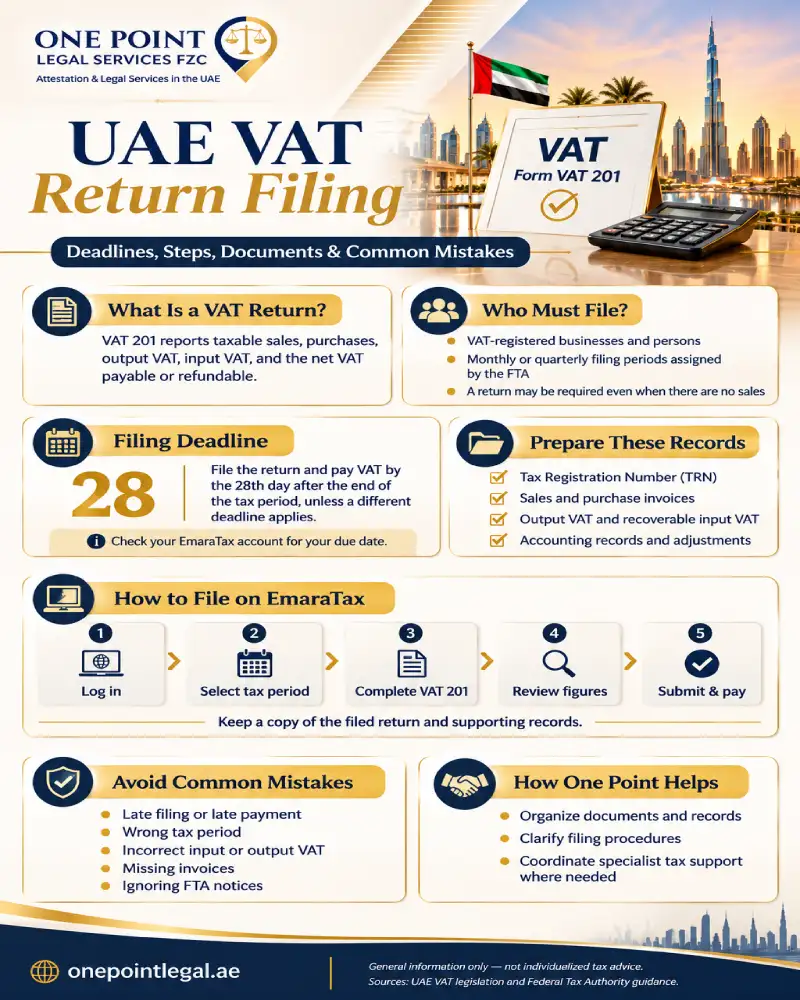
The UAE VAT return (Form VAT 201) is an official document submitted by persons registered for VAT to the Federal Tax Authority to summarize sales and purchases and calculate the net tax due or refundable for the tax period. Compliance is not limited to registration; it also includes periodic disclosure and payment of dues within the specified deadlines.
One Point helps companies and investors organize the documents and the legal and procedural requirements related to the VAT return, and coordinate specialized tax support when needed within the scope of its services. You can reach us through the WhatsApp button at the bottom of the page to learn the appropriate path for your situation.
In this guide, you will learn what the return is, who must file it, the 2026 filing deadlines, the steps to file via EmaraTax, and the most notable penalties and common mistakes to watch out for.
Missed a VAT return deadline or found an error in a filed return? One Point will help organise your documents and identify the next step.
Or keep reading to learn about deadlines, filing steps and penalties.
What is the UAE VAT return?
The UAE VAT return is the tax report submitted by a VAT-registered person to the Federal Tax Authority for each tax period, and it includes details of taxable supplies, output tax, input tax, and the net tax due or refundable. The return is filed electronically through the EmaraTax platform within the prescribed statutory period.
What is the difference between tax registration and filing a tax return?
Although the two procedures are linked, each has a different purpose, as follows:
- Tax registration: registering the person or establishment with the Federal Tax Authority and obtaining the Tax Registration Number (TRN).
- Filing the tax return: the periodic disclosure of sales, purchases, and tax due for each tax period after registration is completed.
Therefore, obtaining the Tax Registration Number does not exempt the establishment from the obligation to file tax returns by their specified deadlines.
Who must file the UAE VAT return?
Persons registered for VAT are required to file the tax return, most notably:
- Companies and establishments registered for VAT.
- Natural or legal persons registered for the tax.
- Establishments for which the Authority has set a monthly or quarterly tax period.
- Tax-registered persons even if no sales or supplies were made during the tax period, where they are required to file for that period.
Why is filing the tax return important?
It helps achieve several objectives, most importantly:
- Complying with tax legislation in the UAE.
- Reducing the risk of administrative penalties resulting from delay or non-filing.
- Calculating the tax due correctly.
- Maintaining a regular tax record with the Federal Tax Authority.
- Reducing the risk of observations or tax-audit procedures.
Therefore, every person registered for VAT should track their tax period and file the return electronically by the specified deadline, even in cases where there are no taxable transactions during that period.
When must you file the UAE VAT return?
Persons registered for VAT must file the VAT return for each tax period set by the Federal Tax Authority. The return is filed electronically through the EmaraTax platform and includes the data related to sales, purchases, and tax due for that period.
What is the tax period?
The tax period is the period of time set by the Federal Tax Authority for each registered person, on the basis of which the tax return is prepared and filed. It may be:
- A monthly tax period for some establishments.
- A quarterly tax period for most companies, as determined by the Authority.
- Any other period adopted by the Authority in accordance with the tax legislation.
The responsibility to file the return begins after registration in the tax system, so it is important to know the conditions and steps for VAT registration in the UAE.
What is the filing deadline?
The return must be filed and the tax due paid no later than the 28th day following the end of the tax period, unless the Authority sets another date. If the deadline falls on an official holiday or a non-working day, it is extended to the first following business day. The deadline for each tax period appears in the registrant’s account on the EmaraTax platform.
What data and documents are required before filing?
Preparing the data before starting to fill in the return helps reduce errors and speed up the filing process, most importantly:
- The Tax Registration Number (TRN).
- Total taxable sales and supplies.
- Output tax due.
- Refundable input tax.
- Issued and received tax invoices.
- Accounting records and financial entries related to the tax period.
- Any tax adjustments that must be included in the return.
Before filing the VAT return
Before filing the return, the following is recommended:
- Review all sales and purchase data.
- Match tax invoices with the accounting records.
- Verify the correct calculation of output tax and input tax.
- Make sure the correct tax period is selected.
- Review the entire return before submitting it via the EmaraTax platform.
Adhering to these steps helps file the VAT return by the specified deadline and reduces the likelihood of errors or resulting penalties.
How to file the UAE VAT return via the EmaraTax platform
After preparing the financial data and tax invoices for the tax period, the VAT return is filed electronically through the EmaraTax platform of the Federal Tax Authority by filling in the tax return form (VAT 201). Entering the data correctly and reviewing it before submission helps reduce errors.
- Log in to the EmaraTax platform: the procedures begin by logging in to the taxpayer’s account on the platform using the login credentials, then selecting the registered establishment.
- Select the tax period: choose the tax period for which the return is to be filed, matching what the Federal Tax Authority has approved.
- Fill in the VAT 201 form: enter the required data in the approved form fields, which include total taxable sales and supplies, output tax due, eligible purchases, refundable input tax, and any tax adjustments or settlements.
- Review the return before submission: match the figures with the accounting records and make sure the invoices are correct and the tax is calculated accurately.
- File the return and pay the tax due: submit the return electronically and pay any tax due within the specified deadline.
- Keep a copy of the return: retain a copy of the return along with the invoices and accounting records for reference when needed or during a tax audit.
Penalties for late filing and errors in the VAT return
Penalties differ according to the type of violation, and a number of penalties and their calculation mechanisms were amended effective 14 April 2026.
Penalty for late filing of the return
If the registrant does not file the tax return within the specified deadline, the penalty is:
- AED 1,000 for the first violation.
- AED 2,000 on repetition of the violation within 24 months.
The obligation to file the return continues even if there are no sales or tax due for the period, as long as the person is registered and required to file the return for that period.
Penalty for late payment of the tax due
When the tax due is not paid on time, a monthly penalty is applied calculated at 14% per annum for each month or part thereof on the unpaid tax amount, starting from the day after the payment due date and on the same date of each subsequent month until payment, in accordance with the mechanism prescribed in the applicable administrative penalties decision.
Filing an incorrect tax return
A penalty of AED 500 is imposed for filing an incorrect tax return, unless the registrant takes one of the actions that exempt the case from this penalty under the decision, such as correcting the return within the deadline set for filing it, or submitting a voluntary disclosure to correct it without the error resulting in a difference in the amount of tax due. Errors that result in a tax difference may also be subject to the voluntary disclosure rules and their associated penalties, depending on the timing of the error’s discovery and correction.
Errors that may lead to penalties
Violations are not limited to late filing or payment; they may also be linked to other errors or obligations, such as:
- Entering incorrect data in the tax return.
- Calculating output tax or input tax inaccurately.
- Selecting an incorrect tax period.
- Claiming non-refundable input tax.
- Not keeping tax invoices or supporting records in accordance with the statutory requirements.
- Not correcting errors in accordance with the prescribed procedures and deadlines when required.
How do you avoid tax penalties?
The risk of tax violations can be reduced by following a number of practices, including:
- Filing the return before the statutory deadline expires.
- Paying the tax due on time.
- Reviewing all data before submitting the return.
- Keeping invoices and accounting records in accordance with the Authority’s requirements.
- Using an accounting system that helps prepare returns accurately.
- Following up on notifications issued by the Federal Tax Authority and responding to them when needed.
Adhering to deadlines, reviewing data, and keeping supporting records helps reduce the risk of penalties and tax observations and strengthens compliance. Tax obligations are not limited to VAT; an establishment may also be subject to Corporate Tax in the UAE under specific conditions.
How does One Point help with VAT return requirements?
One Point Legal Services helps review the legal and regulatory aspects related to the file, organize the required documents and records, clarify the steps to file the return via EmaraTax, and coordinate specialized support when needed within the scope of its services. The support may include:
- Organizing the documents, invoices, and records relevant to the return.
- Reviewing the procedural requirements and correspondence issued by the Authority.
- Assisting in identifying the required documents when there is a completion request.
- Coordinating specialized tax support when there are previous errors, a voluntary disclosure, or a tax audit.
Scope of service: The registered person can file the VAT return themselves through the EmaraTax platform. If the case requires professional representation before the Authority or services that fall within the tasks of a tax agent, this is done through a tax agent or tax agency registered and approved with the Federal Tax Authority. If you need to review the return requirements or organize the file documents, the One Point team can help you determine the next step and coordinate the appropriate path for your situation.
Frequently Asked Questions
What is the UAE VAT return?
It is a tax return submitted by the registered person to the Federal Tax Authority for their specified tax period, including data on supplies, purchases, output tax, input tax, and the net tax due or refundable.
How can I file the VAT return?
The return is filed electronically through the Federal Tax Authority's EmaraTax platform by logging in, selecting the tax period, entering the required data, then reviewing the return, submitting it, and paying any tax due.
What is the deadline for filing the VAT return?
The return must be filed and the tax due paid no later than the 28th day following the end of the tax period, unless the Authority sets another date. If the deadline falls on an official holiday or a non-working day, it extends to the first following business day.
When is the tax return filed for 2026?
Returns continue to be filed throughout 2026 according to the tax period set for each registrant, and the filing and payment deadline for each period appears in the registrant's account on the EmaraTax platform.
What are the steps to file the VAT return?
The steps include logging in to the EmaraTax platform, selecting the tax period, entering output tax and input tax data, reviewing the figures against the accounting records, then submitting the return and paying the tax due within the specified deadline.
Must the return be filed if there are no sales?
Yes, the registered person remains obligated to file the return for their specified tax period even if no sales or supplies were made during that period.
What is the penalty for late filing of the return?
The penalty for failing to file the return by the specified deadline is AED 1,000 for the first violation, rising to AED 2,000 on repetition within 24 months. If there is unpaid tax, the late-payment penalty may also apply independently.
Read also
The UAE VAT return is one of the periodic obligations of persons registered for VAT, and filing it by the specified deadline and reviewing the data, invoices, and accounting records helps reduce the risk of penalties and violations. If you need to review the VAT return requirements or organize the related documents, the One Point team can help you determine the next step and coordinate specialized support when needed.
Disclaimer: The information in this article is for general awareness and does not constitute customized tax advice. The effects of errors, disclosures, and penalties differ according to the facts of each case and their timing. When a case requires professional representation before the Authority within the tasks of a tax agent, this must be done through a tax agent or tax agency registered with the Federal Tax Authority.
Legal sources
- Federal Decree-Law No. 8 of 2017 on Value Added Tax and its effective amendments, including the 2024 and 2025 amendments.
- The Executive Regulation of Federal Decree-Law No. 8 of 2017 and its effective amendments.
- Cabinet Decision No. 40 of 2017 on administrative penalties for tax violations and its amendments, including Cabinet Decision No. 129 of 2025 effective 14 April 2026.
- Federal Tax Authority – filing VAT returns and paying tax via the EmaraTax platform.
