

VAT registration is one of the most important statutory obligations that may apply to companies and entrepreneurs in the United Arab Emirates when they meet the registration conditions set by the Federal Tax Authority through the EmaraTax platform. Understanding the registration requirements from the start of the activity helps with compliance with tax regulations, avoiding penalties, and ensuring that tax obligations are managed correctly.
One Point helps companies and investors review the legal and regulatory requirements related to VAT registration, prepare the documents, and coordinate procedures within the scope of its services. You can reach our team through the WhatsApp button at the bottom of the page to learn the appropriate path for your situation.
In this comprehensive guide, you will learn the VAT registration conditions, the mandatory and voluntary registration thresholds, the required documents, the steps to apply through the online platform, and the mechanism for obtaining the Tax Registration Number (TRN), in addition to the most notable mistakes to avoid in order to comply with the tax requirements in the UAE.
Unsure whether VAT registration is mandatory for your business? One Point will review your documents and the EmaraTax filing steps.
Or keep reading to learn about thresholds, documents and registration steps.
What is VAT registration?
VAT registration means registering the natural or legal person with the Federal Tax Authority to obtain the Tax Registration Number (TRN), which enables the person to collect and remit VAT in accordance with the provisions of the tax legislation in the United Arab Emirates. Registration is either mandatory or voluntary depending on the value of taxable supplies and the fulfilment of the statutory conditions.
Why is VAT registration important?
Tax registration is not limited to regulatory compliance; it also achieves several vital benefits for companies and establishments, most notably:
- Complying with the requirements of the Federal Tax Authority.
- Issuing compliant tax invoices in accordance with the applicable legislation.
- The ability to recover input tax upon meeting the statutory conditions.
- Reducing the risk of penalties and sanctions resulting from failing to register on time.
- Enhancing the company’s credibility in its commercial dealings in the market.
The authority responsible for tax registration
The Federal Tax Authority manages the VAT system in the UAE, including receiving registration applications through the EmaraTax platform, issuing the Tax Registration Number (TRN), following up on registrants’ obligations, and overseeing compliance with the provisions of the tax legislation.
Who must register for VAT?
A number of persons and establishments are required to register when the registration conditions are met, most notably:
- Commercial companies and establishments of various forms.
- Entrepreneurs and project owners.
- Service providers and professional activities.
- Any person conducting an economic activity who exceeds the mandatory registration threshold, or meets the voluntary registration conditions under the tax legislation.
Therefore, it is advisable to review the value of taxable supplies periodically to confirm whether VAT registration is mandatory, and to submit the application within the statutory period to avoid any penalties or additional obligations.
Conditions and requirements for VAT registration in the UAE
VAT registration depends on meeting the conditions set by the tax legislation in the UAE, starting with determining whether registration is mandatory or voluntary according to the value of taxable supplies. Preparing the documents and financial data correctly also helps speed up the registration procedures and avoid completion requests or delays.
When is registration mandatory?
For businesses resident in the UAE, VAT registration becomes mandatory if the total value of taxable supplies and imports exceeded AED 375,000 during the previous twelve months, or if it is expected to exceed this threshold during the next thirty days. Non-resident businesses that make taxable supplies in the UAE are required to register regardless of the value of the supplies if there is no other person within the country responsible for paying the tax due on those supplies. Before applying, the following is recommended:
- Accurately calculate the value of taxable supplies and imports.
- Review the actual and expected values relevant to registration.
- Submit the registration application within the statutory period after the mandatory condition is met.
When is registration voluntary?
Resident businesses may register voluntarily if the value of their taxable supplies and imports, or their taxable expenses, exceeded AED 187,500 during the previous twelve months, or if it is expected to exceed this threshold during the next thirty days.
Documents required for registration
Documents vary according to the legal form and nature of the activity, and may include:
- The certificate of incorporation, memorandum of association, or partnership agreement, as applicable.
- The commercial register or any official document issued by the licensing authority.
- The trade licence and its branches, where available.
- The Emirates ID and passport of owners and authorized signatories, as applicable.
- The power of attorney or authorization document for the authorized signatory when needed.
- Financial and commercial documents supporting the value of supplies, imports, or expenses relevant to registration.
- Any additional documents requested by the Authority according to the nature of the activity and the application.
The registration provisions apply to the natural or legal person conducting an economic activity in the country once the registration conditions are met, even if they do not hold a trade licence, in accordance with the Federal Tax Authority’s conditions.
Before submitting the registration application
To avoid delay in issuing the Tax Registration Number (TRN), it is recommended to review the following points:
- Verify that all data of the establishment or applicant is correct.
- Review the calculation of supplies, imports, and expenses relevant to registration.
- Prepare the documents in clear and complete formats.
- Verify that the economic activity matches the submitted data.
- Confirm that the mandatory or voluntary registration conditions are met.
Meeting these requirements and preparing the documents in advance helps facilitate VAT registration, speed up the review of the application, and comply with the prescribed tax obligations in the UAE.
VAT registration steps
After confirming that the VAT registration conditions are met and preparing all the required documents, the procedures begin electronically through the EmaraTax platform of the Federal Tax Authority. Following these steps in order helps facilitate the review of the application.
1. Create an account on the online portal
The procedures begin by logging in to the EmaraTax platform or creating a new taxpayer account, then creating a profile for the taxable person and selecting the VAT registration service.
2. Fill in the registration form
The application form is completed by accurately entering the establishment’s data, which includes:
- Company and economic activity data.
- Trade licence details, where available.
- Data of the owner or partners and the authorized signatory.
- Information on supplies, imports, and values relevant to registration.
3. Upload the required documents
The required supporting documents are attached according to the legal form and nature of the activity, such as incorporation or licensing documents, identity documents, and financial and commercial documents supporting the application.
4. Submit and review the application
After confirming the accuracy and completeness of the data, the application is submitted electronically for the Federal Tax Authority to review and verify the information and documents provided.
5. Issuance of the Tax Registration Number (TRN)
Upon approval of the application, the Authority issues the Tax Registration Number (TRN), which proves the person’s VAT registration and is used in tax invoices, returns, dealings, and correspondence that require it to be shown, in accordance with the applicable legislation.
What happens after completing VAT registration?
After obtaining the Tax Registration Number (TRN), the establishment is bound by a number of statutory duties to ensure ongoing compliance, most notably:
- Issuing tax invoices in accordance with the applicable legislation.
- Filing tax returns by the legally specified deadlines.
- Paying the taxes due to the Authority by the prescribed deadlines.
- Keeping accounting records, books, and documents throughout the statutory periods.
- Updating the registration data with the Authority when changes requiring this occur, in accordance with the approved procedures.
Adhering to these steps and requirements helps reduce the risk of delay or penalties associated with non-compliance.
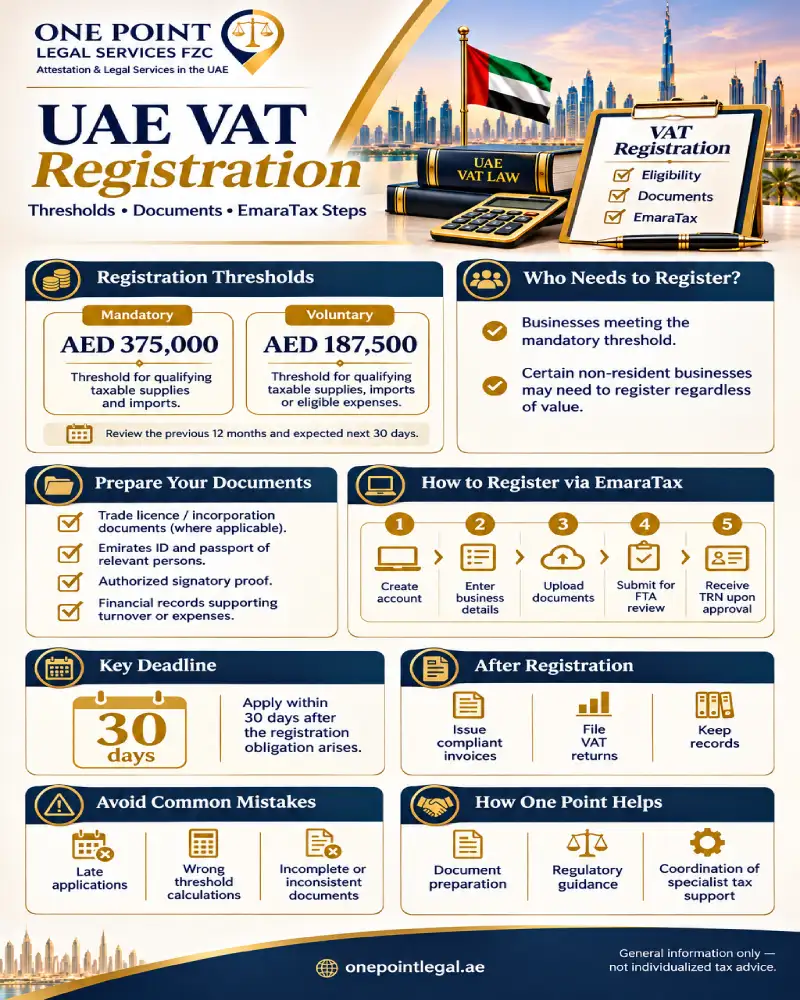
VAT registration thresholds and late-registration penalties
The timing of the application differs according to the value of taxable supplies and imports, not the date of the company’s incorporation alone. Therefore, the establishment must continuously track the actual and expected values to avoid exceeding the statutory threshold without submitting the VAT registration application by the specified deadline.
1. The mandatory registration threshold
Registration becomes mandatory for resident businesses if the value of taxable supplies and imports exceeded AED 375,000 during the previous twelve months, or when it is expected to exceed this threshold during the following thirty days. Non-resident businesses that make taxable supplies in the country may be required to register without applying this threshold if there is no other person within the country responsible for paying the tax due on those supplies. When calculating the mandatory threshold, the relevant elements are reviewed in accordance with the legislation, including:
- Taxable supplies.
- Zero-rated supplies.
- Taxable imports.
- Values expected to be realized during the following thirty days.
- The activities and branches of the same person, where applicable.
2. The voluntary registration threshold
Resident businesses may apply for voluntary registration if the value of their taxable supplies and imports, or their taxable expenses, exceeded AED 187,500 during the previous twelve months, or when it is expected to exceed this threshold during the following thirty days.
Note: This option may be suitable for some new companies or establishments with taxable setup expenses, taking into account the obligations that result from registration.
When must the registration application be submitted?
The person required to register must submit their application to the Federal Tax Authority through the EmaraTax platform within 30 days from the date the registration obligation arises. Exceeding this period leads to the application of the late-registration penalty under the applicable tax legislation.
Penalties for failing to register on time
The Authority imposes an administrative penalty for failing to submit the VAT registration application within the statutory period. The delay may also entail additional obligations depending on the case, such as:
- Calculating the tax due for the relevant periods.
- The need to process previous invoices and accounting records in accordance with the statutory requirements.
- Filing the necessary returns or corrections where applicable.
Reasons for delay in issuing the Tax Registration Number (TRN)
Approval of the application or issuance of the tax number may be delayed for the following reasons:
- Failure to provide sufficient evidence that the registration conditions are met.
- A conflict or difference between the licence or document data and the submitted form.
- A shortage of financial data or supporting documents.
- Lack of clarity about the nature of the economic activity or the movement of supplies.
- Attaching unclear or outdated documents when valid documents are required.
- Failure to respond to the Authority’s completion requests within the specified period.
One Point tip: Careful review of the data, determining the date the obligation arises, and preparing the supporting documents in advance help reduce registration errors and the risk of delay or penalties.
Common mistakes when registering for VAT and how to avoid them
Some companies make mistakes during VAT registration that lead to delay in issuing the Tax Registration Number (TRN) or the imposition of penalties due to non-compliance with the tax requirements. Most of these mistakes can be avoided by reviewing the data and documents and verifying the accuracy of the information before submitting the application through the EmaraTax platform.
The most common registration mistakes
- Delaying the registration application after the registration obligation arises and exceeding the specified deadline.
- Calculating supplies, imports, or expenses relevant to registration incorrectly.
- Submitting incomplete, outdated, or unclear documents.
- Entering data that does not match the official documents.
- Selecting an economic activity that does not accurately reflect the establishment’s actual business.
- Failing to disclose the activities or branches that must be included in the registrant’s profile.
How do you avoid tax penalties and violations?
Adhering to a number of vital practices helps reduce the risk of violations, including:
- Tracking the values relevant to registration periodically to know exactly when the obligation arises.
- Keeping accurate, organized, and up-to-date financial and accounting records.
- Reviewing all data and inputs carefully before submitting the registration application.
- Updating the company’s data with the Authority when a change requiring an update occurs, in accordance with the approved procedures.
- Adhering to the statutory deadlines for submitting the application and subsequent tax returns.
The relationship between tax registration and company formation
VAT registration is linked to the stage of starting and growing the activity, as tax obligations arise according to the nature of the activity, the supplies, the imports, and the values realized during the legally specified periods. Therefore, it is advisable to review the tax position from the start of the project to determine whether registration is mandatory or voluntary, and to set up an accounting system that helps comply with the Federal Tax Authority’s requirements. Reviewing the tax position periodically, keeping accurate financial records, and seeking specialists when needed all help reduce the risk of penalties or delay and improve the company’s readiness for tax compliance. After VAT registration, returns must be filed on time to avoid penalties, and you can learn when you fall into the trap of UAE VAT return penalties.
How does One Point help with VAT registration requirements?
One Point Legal Services helps review the legal and regulatory position of the activity, gather the required documents and data, clarify the registration path and EmaraTax platform requirements, and coordinate the procedures related to the application within the scope of its services. The support may include:
- Reviewing the company, licence, and legal documents.
- Organizing the financial and commercial documents supporting the application.
- Reviewing the correspondence or completion requests related to the file.
- Clarifying the registration procedures and EmaraTax platform requirements.
- Determining whether the case requires specialized tax support.
Scope of service: An eligible person can submit the registration application directly to the Federal Tax Authority through the EmaraTax platform, and appointing a tax agent is not required to submit the registration application. If the client needs professional representation before the Authority or services that fall within the tasks of a tax agent, this is done through a tax agent or tax agency registered with the Authority in accordance with the applicable legislation. If you need to review the registration requirements, the One Point team can help you determine the documents and the next step and coordinate the appropriate path for your situation.
Frequently Asked Questions
How can I register for VAT in the UAE?
Registration is done electronically through the Federal Tax Authority's EmaraTax platform, by creating the account and tax profile, then selecting the VAT registration service, filling in the data, attaching the required documents, and submitting the application for review.
When is VAT registration mandatory?
For businesses resident in the UAE, registration is mandatory if the value of taxable supplies and imports exceeded AED 375,000 during the previous twelve months, or when it is expected to exceed this threshold during the next thirty days. Non-resident businesses are subject to special rules and may be required to register without applying this threshold if there is no other person responsible for paying the tax on their supplies within the country.
Can you register for VAT voluntarily?
Yes, resident businesses may apply for voluntary registration if the value of their taxable supplies and imports, or their taxable expenses, exceeded AED 187,500 during the previous twelve months, or if it is expected to exceed this threshold during the next thirty days.
What papers and documents are required for registration?
Documents vary according to the legal form and nature of the activity, and may include incorporation or partnership documents, the commercial register or trade licence where available, the identity and passport of owners and authorized persons, authorization documents, and the financial and commercial evidence that supports the registration application.
What is the Tax Registration Number (TRN)?
It is a number issued by the Federal Tax Authority after the registration application is accepted, proving the person's VAT registration and used in invoices, returns, correspondence, and tax dealings that require it to be shown.
What is the penalty for not registering for VAT?
The Authority applies the administrative penalty prescribed in the applicable legislation for failing to submit the registration application within the specified period, and tax obligations related to previous periods may also arise depending on the effective date of registration and the circumstances of the case.
How long does the issuance of the registration number take?
The Federal Tax Authority currently sets an estimated period of 20 business days to complete the review of the registration application from the date the complete application is received. The period may be extended if the Authority requests additional documents or information before making a decision. The VAT registration service through the Federal Tax Authority is currently free.
VAT registration is an essential step for establishments subject to the tax regulations in the UAE to comply. Understanding the registration thresholds, preparing the documents, and adhering to the prescribed deadlines help reduce the risk of delay and violations. If you need to review the VAT registration requirements, the One Point team can help you determine the documents, the scope of service, and the next step. If you are a business owner, tax obligations are not limited to VAT; you can also learn about the conditions of Corporate Tax in the UAE and the requirements for being subject to it.
Disclaimer: This content is for general awareness and does not constitute customized tax advice or a guarantee that the registration application will be accepted. The Federal Tax Authority determines registration eligibility, its effective date, and completion requirements according to the facts, documents, and legislation applicable to each case.
Legal sources
- Federal Decree-Law No. 8 of 2017 on Value Added Tax and its effective amendments, including the amendments issued by Federal Decree-Law No. 16 of 2024 and Federal Decree-Law No. 16 of 2025.
- The Executive Regulation of Federal Decree-Law No. 8 of 2017 and its effective amendments.
- Federal Tax Authority – the VAT registration service through the EmaraTax platform.
- Federal Decree-Law No. 28 of 2022 on Tax Procedures and its Executive Regulation, with regard to tax agents where applicable.
