

Corporate Tax in the UAE generally applies at 0% on taxable income not exceeding AED 375,000, and 9% on the portion of taxable income exceeding AED 375,000, for tax periods starting on or after 1 June 2023, with special provisions for certain categories such as Qualifying Free Zone Persons and multinational enterprises subject to the top-up tax.
One Point helps companies review the legal and regulatory aspects related to Corporate Tax, prepare registration documents, and coordinate procedures and specialized tax support when needed within the scope of its services. You can reach us through the WhatsApp button at the bottom of the page.
In this guide, we cover registration conditions, tax rates, exemptions, Small Business Relief, and how to reduce the risk of penalties related to Corporate Tax in the UAE for establishments and companies.
Not sure whether your company must register for UAE corporate tax? One Point will review your documents and the registration path for your case.
Check Corporate Tax Registration
Or keep reading to learn about rates, registration requirements and penalties.
What is Corporate Tax in the UAE?
Corporate Tax in the UAE is a direct tax imposed on the taxable income generated by companies and some natural persons who carry out a commercial activity or business within the UAE, in accordance with the Corporate Tax Law and the decisions issued thereunder. The system aims to enhance transparency and tax compliance while preserving the competitiveness of the country’s business environment.
What are the objectives of Corporate Tax?
Applying Corporate Tax in the UAE aims to achieve a set of strategic objectives, most notably:
- Strengthening tax compliance and governance.
- Supporting the sustainability of public finances in the country.
- Aligning the tax system with adopted international standards.
- Enhancing investor confidence in the UAE business environment.
- Consolidating the UAE’s position as a leading global economic and investment hub.
What is the difference between Corporate Tax and VAT?
Although both fall within the UAE tax system, there is a fundamental difference between them:
- Corporate Tax: imposed on the taxable income or profits generated by companies and persons subject to the law.
- VAT: imposed on the supply of goods and services, with the registered person collecting it and remitting it to the Federal Tax Authority.
Therefore, a company may be registered for both Corporate Tax and VAT, with independent obligations and separate accounting for each tax system.
What is the Corporate Tax rate in the UAE?
Corporate Tax applies according to the following basic rates, subject to exemptions and special regimes:
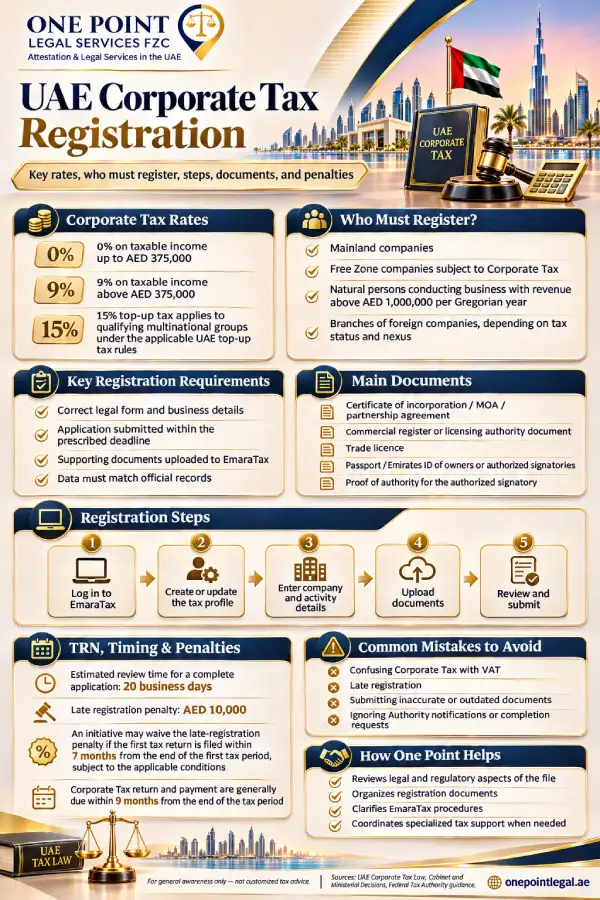
- 0%: on the portion of taxable income not exceeding AED 375,000.
- 9%: on the portion of taxable income exceeding AED 375,000.
Top-up tax for multinational enterprises
The 15% rate is not a general Corporate Tax bracket. The UAE has applied the Domestic Minimum Top-up Tax to entities that are members of multinational enterprise groups with annual global revenues of EUR 750 million or more in at least two of the four preceding financial years, for financial years starting on or after 1 January 2025. The regime aims to achieve the effective minimum tax rate of 15% under the applicable top-up tax rules.
Small Business Relief
A qualifying resident person may elect to apply Small Business Relief if its revenue does not exceed AED 3,000,000 in the relevant tax period and in all relevant previous tax periods. When the relief is elected, the person is treated as not having derived any taxable income for that period. This relief is not available to a Qualifying Free Zone Person or to a member of a multinational enterprise group whose consolidated revenues exceed the prescribed threshold. Under Ministerial Decision No. 131 of 2026, the application of Small Business Relief was extended to cover tax periods ending on or before 31 December 2029. This relief does not exempt the taxable person from registration or from filing a return; rather, it is elected when filing the tax return for the relevant period if its conditions are met.
Who is required to register for Corporate Tax?
Registration for Corporate Tax in the UAE is not limited to a single category, as the law defines taxable persons according to the nature of the activity, the legal form, the place of incorporation, and other criteria. The status of each person or establishment should therefore be reviewed to determine registration and compliance obligations.
Mainland companies
Companies incorporated in the mainland within the UAE are subject to the provisions of the Corporate Tax Law unless a legally prescribed exemption applies, and taxable persons are required to register and fulfil the prescribed tax requirements.
Free Zone companies
Persons established in Free Zones who are subject to Corporate Tax must register; being located in a Free Zone does not automatically exempt a company from the tax. A Qualifying Free Zone Person may benefit from the 0% rate on qualifying income if all conditions are met, while non-qualifying income is subject to the applicable provisions and rates under the Corporate Tax Law.
Sole establishments and natural persons
A natural person is subject to Corporate Tax if they conduct a business or business activity in the UAE and their total revenue from that activity exceeds AED 1,000,000 during the Gregorian calendar year. This threshold does not include wages, personal investment income, or real estate investment income under the prescribed rules. Accordingly, a natural person does not become subject merely by receiving these types of income if they fall within the categories excluded for Corporate Tax purposes.
Branches of foreign companies
Branches of foreign companies that carry out an activity within the UAE are subject to the provisions of the tax system depending on the nature of the activity, the existence of a permanent establishment or nexus with the country, and the provisions of the law and relevant tax treaties.
Do all companies pay Corporate Tax?
Registration does not mean that all registered persons will pay the tax in the same way or at the same rate, as the outcome differs according to the situation of each establishment, including:
- Persons subject to tax under the applicable legislation.
- Persons or entities benefiting from a legally prescribed exemption upon meeting its conditions.
- Qualifying Free Zone Persons in respect of their qualifying income.
- Qualifying resident persons who elect to apply Small Business Relief upon meeting its conditions.
Therefore, registering in the tax system does not mean that all profits are subject to the same rate; this depends on the nature of the person, the activity, the income level, and the extent to which the conditions for exemptions or special regimes and reliefs are met.
Corporate Tax registration conditions and steps
Persons subject to the provisions of Corporate Tax in the UAE must meet the registration requirements with the Federal Tax Authority within the specified deadlines, in order to obtain the Tax Registration Number (TRN) and comply with the prescribed tax obligations.
When must you register for Corporate Tax?
Registration deadlines differ according to the type of taxable person and the date the obligation arises. The deadlines set by the Federal Tax Authority must therefore be referred to, and the registration application submitted within the period prescribed for each category. For a resident natural person who conducts a business or business activity in the UAE and whose total revenue from this activity exceeds AED 1 million during a Gregorian year, the registration application must be submitted no later than 31 March of the following Gregorian year. In addition to Corporate Tax, an establishment may be required to register for VAT when its conditions are met.
Corporate Tax registration conditions and requirements
The obligation to register depends on the person’s status and the extent to which they are subject to the Corporate Tax Law, not on the existence of a trade licence alone. The basic requirements include:
- That the person is among the categories subject to Corporate Tax under the law and executive decisions.
- Submitting the registration application within the period prescribed for the category to which the person belongs.
- Entering the person’s data, activity, and legal form correctly.
- Providing the required supporting documents according to the nature of the person and their activity.
Documents required for registration
Documents vary according to the legal form and situation, and may include:
- The certificate of incorporation, memorandum of association, or partnership agreement, where available.
- The commercial register or the official document issued by the licensing authority.
- The trade licence and its branches, where available.
- The Emirates ID and passport of owners and authorized persons as applicable.
- A document proving the authority of the authorized signatory.
- Any additional documents requested by the Authority according to the type of person and application.
Registration steps via the EmaraTax platform
The registration application can be submitted electronically through the EmaraTax digital platform by following these steps:
- Create a new account or log in to the official EmaraTax platform.
- Create the company’s tax profile or update it if it already exists.
- Fill in the company data, economic activity, and required information.
- Upload the required documents digitally.
- Carefully review the data, then submit the application officially.
- Track the application status until the Tax Registration Number is issued.
Completing the data and documents correctly helps reduce the likelihood of a request for completion or a delay in reviewing the registration.
Tax Registration Number and penalties in Corporate Tax
After the registration application is accepted, the Federal Tax Authority issues the Tax Registration Number for Corporate Tax, which is used in managing the file, obligations, returns, correspondence, and tax procedures that require it to be shown to the Authority.
What is the Tax Registration Number (TRN)?
The Tax Registration Number is an identification number issued by the Authority to the registered person and used to manage their file and tax obligations with the Federal Tax Authority.
When is the Tax Registration Number used?
- Filing tax returns.
- Communication and correspondence with the Federal Tax Authority.
- Managing the tax file via the EmaraTax platform.
- Tax procedures that require proof of registration.
- Updating data with the Authority when needed.
How long does the registration process take?
The Federal Tax Authority currently sets an estimated period of 20 business days to review a complete registration application. The Authority may request additional information or documents, in which case the completion time of the application is affected depending on the completion of the required data.
Penalty for late Corporate Tax registration
The administrative penalty currently prescribed for failing to submit a Corporate Tax registration application within the specified period is AED 10,000. The Authority applies an initiative to waive the late-registration penalty upon meeting its conditions, most notably filing the first tax return within 7 months from the end of the taxable person’s first tax period, or the annual return for the relevant exempt person, in accordance with the terms of the initiative. After registration, the Corporate Tax return must be filed and the tax due paid within a period not exceeding 9 months from the end of the tax period, unless a special provision applies.
Reasons for delay in issuing the Tax Registration Number
The issuance of the Tax Registration Number may be delayed in some cases, the most prominent reasons being:
- A shortage of required documents or data in the file.
- A difference or conflict between the person’s data and the official documents.
- Failure to complete the tax file requirements on the platform.
- Providing inaccurate or outdated information.
- Failure to respond to completion requests issued by the Authority.
Preparing documents, reviewing data, and responding to completion requests help reduce the likelihood of a delay in processing the application. Companies also need to comply with the deadlines and procedures for filing the Corporate Tax return, and you can also learn about the penalties and details of the VAT return.
Common mistakes when registering for Corporate Tax
Some companies make regulatory mistakes during Corporate Tax registration in the UAE, or after obtaining the Tax Registration Number, which may lead to penalties, delayed procedures, or tax compliance issues.
The most common mistakes
- Believing that not making a profit automatically means there is no obligation to register.
- Confusing Corporate Tax with VAT despite the different obligations of each.
- Providing inaccurate or outdated data or documents.
- Registering late, beyond the specified period.
- Failing to update data that must be updated with the Authority when a change occurs.
- Neglecting to follow up on notifications or data-completion requests issued by the Authority.
The relationship between Corporate Tax and setting up a business
Corporate Tax obligations should be taken into account from the company’s incorporation stage, because the legal form, the nature of the activity, and the place of conducting business may affect the tax obligations and registration requirements. Early organization of records and tax requirements also helps reduce future legal and procedural problems.
How do you avoid tax violations?
Companies can strengthen their tax compliance by following a number of practices, including:
- Verifying liability to Corporate Tax before the registration deadline expires.
- Reviewing the company’s data and documents before submitting the application.
- Keeping accurate and organized financial and accounting records in accordance with the applicable requirements.
- Updating official data with the Authority when an update is required.
- Following up on the statutory deadlines for registration, filing returns, and payment.
- Seeking specialized tax support when there are matters that require professional tax assessment.
Adhering to these practices helps reduce the risk of penalties or violations and strengthens compliance with tax legislation in the UAE.
How does One Point help with Corporate Tax requirements?
One Point Legal Services helps review the legal and regulatory aspects related to the company, organize registration documents and the corporate file, clarify the registration procedures via the EmaraTax platform, and coordinate specialized tax support when needed within the scope of its services. The support may include:
- Reviewing the company and incorporation documents related to the registration file.
- Organizing the data and documents required for registration.
- Reviewing the procedural requirements, correspondence, and completion requests issued by the Authority.
- Determining the appropriate path when there are matters related to Free Zones, structuring, or tax obligations.
- Coordinating specialized tax support when needed.
Scope of service: The taxable person can register and file their return directly through the EmaraTax platform. When the file requires specialized tax consultancy or professional representation before the Authority within the tasks of a tax agent, this is done through a tax agent or tax agency registered and approved with the Federal Tax Authority. If you need to review Corporate Tax requirements or prepare registration documents, the One Point team can help you determine the scope of service and the next step, and coordinate specialized support when needed.
Frequently Asked Questions about UAE Corporate Tax Registration
No schema found.Read also
Complying with Corporate Tax requirements in the UAE is an essential step for managing tax obligations in an organized manner and reducing the risks of delay and violations. If you need to review Corporate Tax requirements, the One Point team can help you determine the scope of service and the next step, while coordinating specialized tax support when needed.
Disclaimer: This content is for general awareness and does not constitute customized tax advice. Liability to tax, the method of calculating income, exemptions, Small Business Relief, the Free Zone regime, and the top-up tax differ according to the nature of the person, the activity, the tax period, and the specific facts of each case.
Legal sources
- Federal Decree-Law No. 47 of 2022 on the Taxation of Corporations and Businesses and its effective amendments.
- Cabinet Decision No. 116 of 2022 on determining the amount of income subject to Corporate Tax.
- Cabinet Decision No. 142 of 2024 on imposing the top-up tax on multinational enterprises.
- Ministerial Decision No. 131 of 2026 on extending Small Business Relief.
- Federal Tax Authority – Corporate Tax registration service and return filing and compliance guidance.
